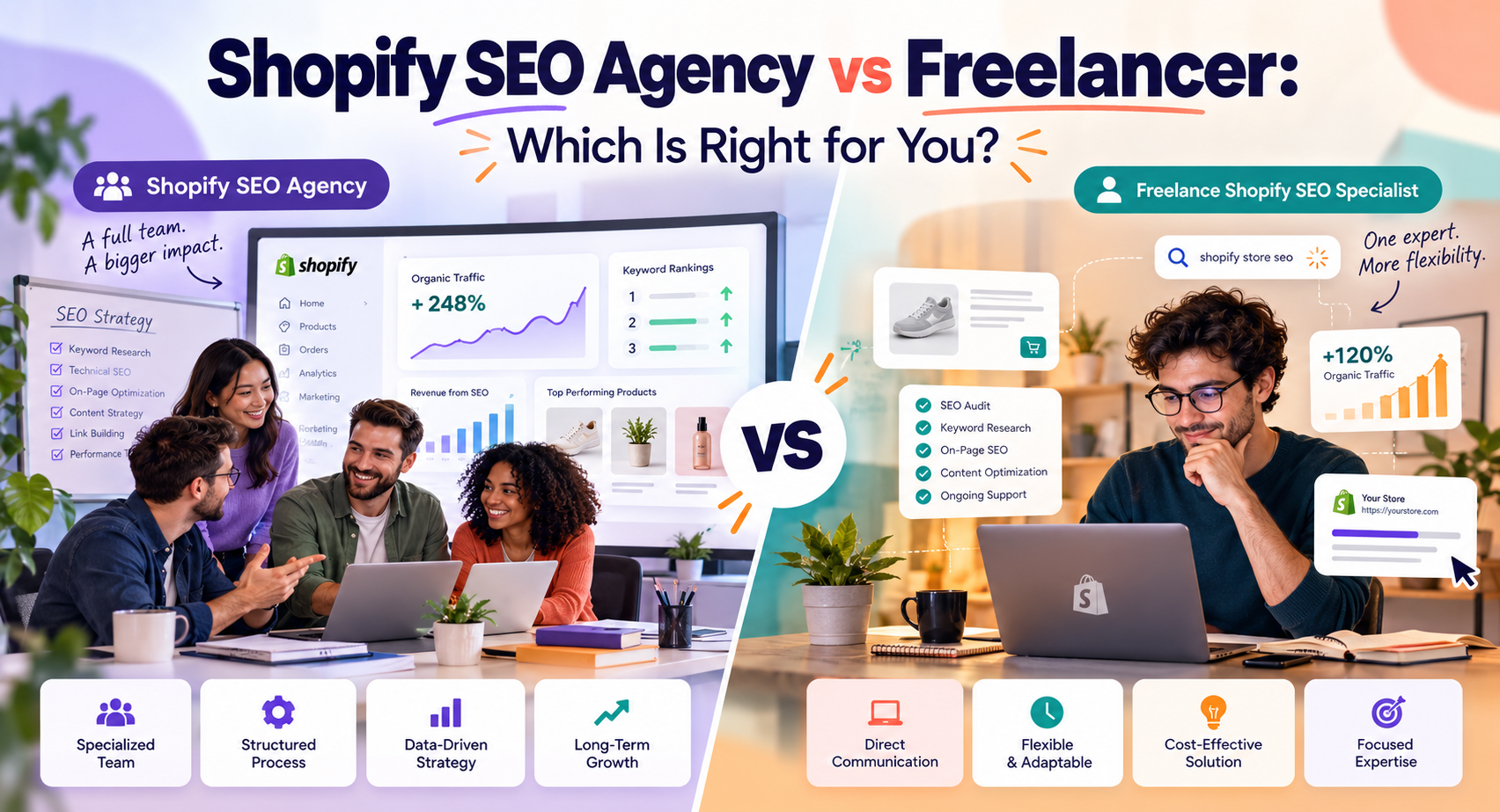
The wrong question is, "Is a Shopify SEO agency better than a freelancer?" The better question is, "What work does my store need, who will implement it, and which capabilities are missing internally?"
Neither a Shopify SEO agency nor a freelancer is inherently the better choice. A specialist freelancer or consultant can be a strong fit when the problem is focused, senior expertise matters and your team can implement recommendations. A specialist agency becomes more useful when technical SEO, content, development, analytics and other workstreams must run in parallel under coordinated external ownership.
There are also valid hybrid and project-based options. The right Shopify SEO delivery model depends more on scope, implementation ownership, Shopify-specific competence, delivery capacity, continuity and evidence than on provider size.
This comparison uses that operating-model approach rather than arbitrary rules based on monthly budget, revenue, Shopify plan or product count.
Shopify SEO Agency or Freelancer? Start With the Work, Not the Label
If you compare providers by label first, you can easily buy the wrong capability. "Agency" tells you that an organization exists. "Freelancer" tells you that responsibility may be concentrated in one person. Neither description tells you who will diagnose your store, who will implement changes, how well they understand Shopify or whether their work matches your actual SEO problem.
Google's own guidance on hiring an SEO is useful here because it does not recommend a company over an individual. Google advises site owners to interview the provider, review previous work, ask how success will be measured, check relevant market experience and understand how recommendations will be communicated and implemented.
Use the same principle for Shopify. First define the job. Then compare the people and delivery model capable of doing that job.
The Real Comparison Is Operating Model, Not Company Size
A Shopify SEO freelancer often concentrates strategy, communication and sometimes implementation in one specialist. That can reduce handoff loss because the person diagnosing the issue may also be the person explaining the recommendation and checking the result.
An agency distributes work across roles. That can create useful capacity when technical changes, content production, analytics, development and coordination need to happen at the same time. It can also create more handoffs, so the value depends on whether those roles are actually needed and whether qualified people are assigned to the account.
Either model can be advisory or hands-on. A freelancer may write briefs only, or may edit themes and implement technical fixes. An agency may provide full execution, or it may deliver recommendations that your team must implement.
Do not infer the delivery model from the provider label. Ask what will actually happen after a recommendation is approved.
Disclosure: This Site Provides Ecommerce SEO Services
VijayBhabhor.com provides ecommerce SEO services, and I work as an independent SEO specialist and consultant. That creates a commercial interest in this topic, so this article does not treat the freelancer or consultant model as the default winner.
The recommendation throughout this guide is based on the work your Shopify store requires, who owns implementation, how much delivery capacity is needed and what evidence the provider can show.
Define the Shopify SEO Problem Before You Choose Who Solves It
Choose the provider only after you have defined the constraint. A Shopify store with indexing problems needs a different capability mix from one with weak collection architecture, poor product discovery, limited content coverage, international localization issues or unreliable analytics.
If the scope is still unclear, diagnose the SEO scope first. The audit method belongs in that guide. For this hiring decision, you need the output: what is wrong, what work is required and which workstreams depend on other workstreams.
At a high level, Shopify SEO work can involve:
- Technical crawl and indexation review
- Collection and category architecture
- Product-page search visibility
- Keyword and demand mapping
- Content strategy
- Internal linking
- Structured data and theme-level implementation
- Search Console and GA4 analysis
- Shopify Markets and international localization
- Digital PR or other legitimate authority-building activity
The purpose of this list is not to create another SEO checklist. It is to identify how many distinct disciplines are actually involved. The broader ecommerce SEO strategy guide owns the implementation detail.
One Focused Constraint Usually Needs Less Delivery Capacity
If one or two problems dominate, one experienced Shopify SEO specialist may be enough. Consider a store with capable developers and writers but weak organic visibility because its collections overlap, internal linking is inconsistent and keyword ownership between collections is unclear.
The merchant may not need an external content team, developer, analytics specialist and project manager. A senior consultant could diagnose the architecture, define the collection strategy, specify internal-linking changes and QA what the internal team implements.
The important qualification is competence. A smaller delivery model works because the scope is focused and internal execution already exists, not simply because one person is cheaper or more senior.
Multiple Workstreams Change the Delivery Model
The decision changes when several workstreams need to move together. Imagine a multi-market Shopify store that needs technical cleanup, localized collection content, analytics validation, theme changes and digital PR during the same growth cycle.
Sequentially assigning all of that work to one person may create a throughput problem even if that person is excellent. A specialist agency, or a deliberately assembled hybrid team, can create value by moving independent tasks in parallel.
That is a capacity argument, not an agency-quality argument. You still need to verify who is responsible for technical SEO, content, analytics, development, QA and authority work.
Separate Shopify Specialization From Delivery Capacity
Shopify specialization and delivery capacity are separate variables. A highly specialized freelancer can understand Shopify architecture better than a large generalist agency. A specialized agency can offer equally strong platform knowledge plus more parallel execution capacity.
This gives you a better comparison than "small versus large."
| Provider Model | Shopify Depth | Parallel Capacity | Typical Strength | Typical Risk to Verify |
|---|---|---|---|---|
| Generalist freelancer | Varies | Low | Direct ownership | Shopify knowledge may be shallow |
| Specialist freelancer or consultant | Potentially high | Usually limited by one person's capacity | Focused senior expertise and direct communication | Availability, workload and continuity |
| Generalist agency | Varies by assigned team | Potentially high | Multiple delivery resources | Team breadth can exist without Shopify SEO depth |
| Specialist Shopify SEO agency | Potentially high | Potentially high | Specialization plus parallel execution | Verify that senior specialists actually work on the account |
The words "potentially" and "usually" matter. Company structure does not prove capability. The table describes operating characteristics to verify, not guarantees.
A Bigger Team Is Not Proof of Deeper Shopify SEO
Capability belongs to the people doing the work. If an agency presents a senior Shopify SEO specialist during sales, ask whether that person will diagnose the account, review implementation and remain involved after onboarding.
Then ask who will handle technical changes, content briefs, development, analytics and QA. A team has value when the relevant expertise is assigned to your account. Employee count alone is not a useful SEO quality metric.
Google's hiring guidance follows the same logic. It recommends evaluating previous work, methods, measurement, communication and relevant experience. It does not treat provider size as evidence of SEO competence.
Direct Specialist Access Is Valuable Only If the Specialist Is Actually Strong
The opposite stereotype also needs correcting. Direct communication with a freelancer or consultant can reduce handoffs, but direct access does not prove expertise.
One person can misdiagnose a store, recommend unnecessary work or become overloaded. A merchant should still ask for relevant Shopify experience, examples of similar problems, implementation detail and a clear measurement process.
Direct access is an operating advantage only when the specialist is strong enough for the scope and has enough capacity to deliver it.
Implementation Ownership Is the Hidden Variable in the Agency-vs-Freelancer Decision
Implementation ownership often predicts provider fit better than store size. The same Shopify store can work successfully with one senior consultant when internal developers and content teams implement recommendations. That store may need more external delivery capacity if nobody internally can ship the changes.
Before requesting proposals, build a simple ownership map:
- Who can edit the Shopify theme?
- Who can work with Liquid when required?
- Who changes collections, navigation and internal links?
- Who creates or revises product and collection content?
- Who implements structured data changes?
- Who validates Search Console and analytics?
- Who tests releases?
- Who owns deadlines when a task crosses SEO, content and development?
If most answers point to your internal team, external SEO can lean toward diagnosis, prioritization, specifications and QA. If most answers are "the SEO provider," implementation capacity becomes part of the buying decision.
Strategy-Only and Full-Implementation Are Separate Buying Decisions
A strategy-only SEO engagement typically diagnoses issues, prioritizes work, prepares specifications or briefs and reviews completed work. A full-implementation engagement also executes some or all of those recommendations.
| Dimension | Strategy-Only Specialist | Full Implementation Partner |
|---|---|---|
| Core deliverable | Diagnosis, roadmap, specifications and QA | Diagnosis plus execution |
| Internal resources required | Usually higher | Potentially lower, depending on scope |
| Execution speed | Depends heavily on merchant team | Depends on provider capacity and dependencies |
| Accountability | Split between advisor and implementers | Can be more consolidated if scope is genuinely owned |
| Cost structure | SEO fee plus internal or external implementation | More implementation may be included in provider scope |
Either model can be delivered by a freelancer or an agency. Do not assume a freelancer is advisory-only or that an agency automatically implements everything it recommends.
Some Shopify SEO Changes Need Development Skills
Not every SEO recommendation needs a developer. Collection copy, keyword mapping, metadata, internal links and many content changes can often be handled without custom development.
Other tasks can require theme or storefront changes. Shopify's own documentation notes that advanced storefront-search customizations can involve HTML, CSS, JavaScript and Liquid. Custom robots.txt.liquid changes also require code and SEO knowledge.
The buying question is therefore not "Does the provider have developers?" It is "Does our diagnosed roadmap require development, and who can implement and QA those specific changes?"
Buying developer capacity before you know whether you need it can add unnecessary cost. Hiring strategy without any implementation path can create the opposite problem: a good roadmap that never reaches production.
What a Shopify SEO Specialist Should Understand Before Touching the Store
A capable Shopify SEO provider should understand both what the platform already handles and where expert intervention becomes useful. Technical sophistication is not demonstrated by changing the largest number of files.
Shopify automatically provides several important SEO foundations, including canonical tags, sitemap.xml and robots.txt generation. It also lets merchants optimize page titles, descriptions, URLs, image alt text and other content.
| Area | Shopify Default | When Expert Review May Be Needed |
|---|---|---|
| Canonical tags | Automatically generated | Custom architecture, duplicate patterns or app/theme behavior creates a diagnosed issue |
| Sitemap | Automatically generated | Indexation diagnosis, market configuration or unexpected content visibility requires review |
| robots.txt | Automatically generated with Shopify defaults | A specific crawl-control problem justifies customization |
| Shopify Markets hreflang | Automatically generated for appropriately configured market and language URLs | Architecture, localization or implementation QA shows a problem |
| Collections | Merchant-controlled structure and content | Intent overlap, weak architecture, internal linking or category targeting needs work |
| Filters | Behavior depends on storefront and configuration | Faceted URLs create crawl, indexation or search-intent problems |
| Theme and Liquid | Theme provides storefront functionality | SEO changes require code or template modification |
| Content strategy | Not solved automatically by the platform | Search demand, page ownership and commercial content need strategic planning |
A Good Provider Knows What Shopify Already Handles
Shopify's built-in SEO documentation states that canonical tags, sitemap.xml and robots.txt are generated automatically. That does not make Shopify technically perfect, and it does not mean those systems should never be reviewed. It means a provider should first prove why customization is necessary.
A proposal that begins with "create an XML sitemap" or "add canonical tags to Shopify" should trigger a follow-up question: What is currently wrong with Shopify's generated implementation?
The same applies to robots.txt.liquid. Shopify warns that incorrect customization can cause significant traffic loss and recommends code and SEO expertise when editing it. The fact that a file can be changed is not evidence that it should be changed.
A strong technical provider should be able to explain both what they would change and what they would deliberately leave alone.
Shopify Markets Changes the International SEO Conversation
International SEO is another area where outdated assumptions can inflate scope. When Shopify Markets is configured with appropriate market-specific URLs and languages, Shopify can automatically generate hreflang tags. It also manages canonical relationships and market-specific sitemap entries.
This does not make international ecommerce SEO automatic. Merchants still need decisions about market architecture, localization, search demand, collection strategy, product availability, internal linking and content quality.
The distinction matters when evaluating a provider. A specialist should know which technical layer Shopify Markets already handles and where strategy or QA is still required. You should not pay for manual reinvention presented as advanced expertise when the platform is already doing the base work correctly.
Use Real Shopify Problems as Capability Tests
Generic questions such as "Do you do technical SEO?" produce generic answers. Give the provider realistic Shopify scenarios and listen to the diagnostic process.
Ask how they would investigate Shopify indexing problems. A useful answer should start with evidence and likely causes rather than immediately proposing robots.txt changes or submitting URLs repeatedly.
Ask how they approach Shopify collection SEO when multiple collections compete for similar intent. You are testing whether they understand architecture, search demand, internal linking and page ownership.
For stores using extensive filters, ask how they decide which filtered states should remain crawlable or indexable. The implementation depth belongs in the Shopify filter SEO guide, but the provider should be able to explain the decision criteria.
Finally, ask when they would modify Liquid or theme code and when they would solve the problem without code. If your roadmap has substantial crawl, indexation or architecture work, the deeper principles are covered in the ecommerce technical SEO guide.
These scenarios test Shopify literacy better than asking how many years the provider has been doing SEO.
When a Shopify SEO Freelancer or Consultant Is the Better Fit
A Shopify SEO freelancer or consultant can be the better operating model when the scope is focused, direct senior access is valuable, internal resources can implement recommendations and the work does not require several external specialists to operate in parallel.
This model is especially practical when the merchant needs a strong diagnostic owner rather than an outsourced SEO department.
Typical conditions include:
- One or two SEO constraints dominate the roadmap.
- The merchant already has a Shopify developer or technical team.
- Internal writers or merchandising teams can execute content work.
- Work can be sequenced rather than delivered simultaneously.
- Direct access to the strategist reduces decision delays.
- The merchant wants external diagnosis, prioritization and QA while retaining execution control.
These are fit conditions, not guarantees. A freelancer still needs to demonstrate relevant Shopify expertise and sufficient availability.
Strong Internal Teams Make Specialist Advisory More Viable
Suppose your developers can implement theme changes, your ecommerce team controls collections and internal links, and your writers can execute content briefs. What is missing may be senior SEO diagnosis rather than more production capacity.
In that situation, one specialist can focus on the highest-leverage work: finding the constraint, mapping search intent, prioritizing changes, writing specifications, reviewing implementation and measuring the result.
The merchant also retains operational control because existing staff continue to deploy changes.
This does not automatically make the model cheaper. Internal developer time, writer time and management time still have costs. It simply means additional external delivery layers may not be necessary.
Check Continuity Before You Depend on One Person
The main operational risk in a single-specialist model is concentration. If one person owns strategy, communication and QA, an extended absence or capacity problem can slow work.
Treat that as a due-diligence question rather than a stereotype. Experienced freelancers may use documented processes, subcontract specialist work, maintain developer relationships or have defined backup arrangements.
Ask:
- How much active work can you handle at once?
- How are recommendations documented?
- Who can support the account if development work exceeds your skill set?
- What happens during leave or unexpected absence?
- Can another qualified person understand the roadmap from your documentation?
If the answers are strong and the scope is appropriate, concentration risk may be acceptable. If the business requires continuous multi-role execution, it may not be.
When a Shopify SEO Agency Earns the Extra Coordination Cost
A Shopify SEO agency earns its place when team capacity solves a real delivery problem. That usually means several specialist workstreams need coordinated execution, the merchant lacks implementation bandwidth, continuity matters and named team members have proven Shopify expertise.
The word "named" matters. Buying an agency should not mean buying an organizational chart. You need to know which strategist, technical specialist, developer, content specialist or analyst will actually work on your store.
Parallel Work Is Where Team Capacity Creates Real Leverage
Consider an ecommerce business preparing for expansion while organic growth is limited by several independent issues. Technical problems need development. Collections need restructuring. Localized content must be produced for new markets. Analytics needs QA. Digital PR work is planned around a product launch.
If those workstreams must progress during the same period, parallel capacity has real value. One specialist may understand the roadmap but cannot personally perform every task at the same time.
A specialist agency can be a better fit if it can prove that the necessary roles are available, appropriately senior and coordinated by one SEO strategy owner.
Store size alone does not establish this need. A Shopify Plus store with strong internal developers and content teams may require only strategic support. A smaller merchant with no internal implementation resources may need more external execution.
Project Management Can Add Value or Friction
Account management and project management are often criticized as overhead. Sometimes they are. Sometimes they solve a real governance problem.
If SEO work crosses merchandising, development, design, content, analytics and leadership teams, someone needs to manage dependencies, approvals and release timing. A capable project manager can keep that work moving and make ownership visible.
The same layer can become inefficient if every technical question passes through several people before reaching the specialist who can answer it.
Ask how communication works:
- Who makes SEO decisions?
- Can you speak directly with specialists when required?
- Who owns the roadmap?
- Who escalates blocked implementation?
- How are QA failures handled?
- What happens when an assigned specialist leaves?
The goal is not minimum communication. It is enough coordination to ship correct work without unnecessary handoff loss.
Hybrid Shopify SEO Can Combine Senior Strategy With Existing Execution
A hybrid model deliberately splits responsibility between internal staff and external specialists. It can work well when the merchant already has useful execution capacity but lacks one or two senior capabilities.
Examples include:
- A consultant owns SEO strategy while the internal developer and content team implement it.
- An agency handles technical SEO and development while the merchant's editorial team owns content.
- An internal SEO lead hires a specialist for migrations, international architecture or a difficult indexation problem.
- A senior Shopify SEO consultant defines the roadmap while separate development and digital PR partners execute defined components.
Hybrid Only Works When Ownership Is Explicit
Splitting the work does not automatically create efficiency. Without explicit ownership, every supplier can assume another person owns the final result.
A workable hybrid arrangement should have:
- One SEO strategy owner
- A named implementation owner for each workstream
- One agreed measurement framework
- A QA process
- Documented handoff rules
- Clear escalation when a dependency is blocked
If three providers use three different roadmaps and three different definitions of success, the hybrid model becomes coordination debt rather than specialist leverage.
A Project or Sprint Can Be Better Than a Retainer for Discrete Work
Some Shopify SEO needs have a clear beginning and end. A migration review, technical audit, collection architecture project or specific indexation investigation can sometimes be scoped as a project instead of an ongoing retainer.
Ongoing content development, authority building, market expansion and continuous performance analysis may justify recurring support.
Choose the engagement model from the work. Do not assume every SEO problem requires a long retainer or that a short engagement is automatically safer.
Compare Total Delivery Cost, Not Just the Monthly SEO Fee
Headline SEO fees are difficult to compare when the scopes are different. A strategy-only consultant and a full-service agency are not selling the same operating model.
Normalize the work before you compare price. Total delivery cost can include the SEO fee, development, content, tools, internal management, external specialists, rework and the cost of implementation delays.
| Cost Component | Freelancer or Consultant | Agency | Hybrid |
|---|---|---|---|
| SEO fee | Usually tied to specialist scope | Depends on team and included delivery | Split across providers or internal resources |
| Development | May be separate unless provider implements | May be included or separately scoped | Often internal or specialist-specific |
| Content | May be advisory, written or separate | May be included through content team | Often divided between internal and external teams |
| Tools | Depends on engagement | Depends on scope | Potential duplication if tools are not standardized |
| Internal management | Can be low with one specialist, higher if several implementers are internal | Can be lower if agency truly coordinates delivery | Can be significant if ownership is unclear |
| Rework and delay | Can rise when implementation handoffs fail | Can rise when agency layers slow specialist access | Can rise when multiple parties use different standards |
This table intentionally contains no universal price ranges. There is no official market price that determines whether an agency or freelancer is right for a Shopify store.
A Strategy-Only Quote and a Full-Service Quote Are Not Comparable
Before comparing proposals, create one normalized scope sheet. Mark whether each quote includes:
- Technical diagnosis
- Keyword and search-demand research
- Collection strategy
- Product-page recommendations
- Content briefs or content production
- Internal linking implementation
- Theme or Liquid changes
- Analytics and Search Console work
- International SEO support
- Development
- QA
- Reporting
- Project management
- Digital PR or authority work
A lower monthly fee may simply exclude work included in the more expensive proposal. A higher fee may also include services you do not actually need.
Price becomes useful only after the delivery scope is comparable.
Coordination Overhead Has a Cost Too
Suppose a consultant creates the roadmap, your developer implements technical work, a writer creates content and another provider handles digital PR. That arrangement can be efficient if each person is strong and the handoffs are controlled.
It can also require substantial merchant time. Someone must resolve conflicts, approve priorities, make sure the developer interpreted specifications correctly and connect performance reporting across providers.
An agency can reduce that coordination burden when it genuinely owns the workstreams. It can also add overhead through internal account-management layers.
Treat coordination as a cost whether it occurs inside the agency or inside your own business.
Vet the Actual Shopify SEO Provider, Not the Agency or Freelancer Label
Once the operating model is clear, evaluate the provider. The strongest evidence is not a title such as "Shopify SEO agency," "consultant" or "Shopify Partner." It is relevant work, clear methodology, implementation ownership, transparent team structure and a measurement approach connected to business outcomes.
Google recommends interviewing prospective SEO providers, reviewing previous work, asking how results will be measured, checking relevant experience and understanding how recommendations will be communicated. It also recommends comparing major third-party SEO advice with official Google Search guidance.
Use that standard whether you are hiring one person or twenty.
Ask Who Will Actually Work on the Account
The person leading the sales call may not be the person responsible for delivery. This is not automatically bad. Specialized teams often divide commercial, strategic and implementation roles deliberately.
You still need to know:
- Who owns SEO strategy?
- Who performs technical diagnosis?
- Who writes specifications?
- Who implements changes?
- Who reviews Liquid or theme changes?
- Who owns content strategy?
- Who performs QA?
- Who reviews performance?
- Who makes the final call when specialists disagree?
For a freelancer, ask the equivalent questions. One person may cover several roles, but any gaps should still have an implementation plan.
Ask for Evidence That Matches Your Shopify Problem
"We increased organic traffic" is weak evidence if your problem is international collection architecture or a complex migration.
Look for work that resembles the constraint you need solved. If indexation is the issue, ask what the provider diagnosed, what was changed and how they determined whether the problem improved. If collection visibility is weak, ask how search intent, category architecture and internal links were handled.
Case studies should also distinguish correlation from implementation. Organic traffic can move because of seasonality, brand demand, promotions, algorithm changes, new products or other factors.
The provider does not need to reveal confidential client information. They should be able to explain the problem, methodology, implementation and measurement clearly enough for you to judge competence.
Use the Shopify Partner Directory as One Signal, Not the Verdict
Shopify's Partner Directory can help with due diligence. The directory lets merchants browse providers by criteria such as services, location and price-related filters, and Shopify encourages buyers to review work samples, reviews, certifications and other partner information.
Shopify also maintains partner tiers based on multiple factors that include experience and success within the Shopify ecosystem.
These are useful signals. They do not guarantee that a provider is the right SEO partner for your store, understands your search problem or will assign the right person to the work.
A Shopify Partner profile should therefore support the evaluation, not replace it.
Ask What the First 90 Days Will Actually Produce
The purpose of asking about the first 90 days is not to demand a ranking guarantee. It is to understand the provider's operating process.
A credible answer should identify likely phases such as:
- Confirm business goals, data access and current performance.
- Diagnose the main technical, architecture, content or measurement constraints.
- Prioritize work by impact, dependency and implementation effort.
- Assign implementation ownership.
- Ship or hand off agreed changes.
- Validate implementation.
- Measure leading and business outcomes.
The exact timing depends on the store and the work. A provider should not promise that SEO will generate a fixed ranking, revenue increase or traffic percentage within 90 days.
You are evaluating whether the provider has a credible operating plan, not buying a guaranteed outcome.
Red Flags: Claims That Sound Advanced but Should Trigger More Questions
Some SEO proposals use confident language where the underlying evidence is weak. Treat the following claims as prompts for deeper due diligence rather than automatic proof that a provider is bad.
Ranking Guarantees and Link Quotas Are Not Evidence of Quality
Google explicitly warns that no SEO can guarantee a number-one ranking. It also classifies links created primarily to manipulate search rankings as link spam, including buying links for ranking purposes, excessive link exchanges and automated link creation.
That does not mean every form of digital PR, sponsorship or editorial link acquisition is prohibited. Legitimate publicity and paid placements can exist, and Google explains how paid links can be appropriately qualified.
The hiring problem is using link volume as the quality metric.
If a proposal promises a fixed number of backlinks each month, ask:
- How are linking opportunities selected?
- Why would those sites mention this business naturally?
- Are paid or sponsored links qualified appropriately?
- What percentage of the work is PR, editorial outreach or purchased placement?
- How is relevance judged?
- What happens if there are no credible opportunities in a given period?
More links is not automatically better SEO.
Modern-Sounding GEO/AEO Packages Still Need Substance
Google's 2026 guidance for AI Overviews and AI Mode is unusually clear: normal SEO fundamentals continue to apply. Google says you do not need special AI files, AI-specific machine-readable markup, special schema or mandatory content chunking to appear in its generative AI Search experiences.
Google also states that llms.txt neither helps nor hurts visibility in Google Search because Google Search ignores it.
This does not mean AI visibility is irrelevant. It means a provider selling "GEO" or "AEO" should explain the actual work being performed.
Useful work could include improving crawlable site structure, creating distinctive expert content, strengthening product and entity information, improving internal linking, resolving indexation problems, enhancing useful structured data where appropriate and measuring Search visibility.
A proposal becomes questionable when the primary value is a special file, special markup or rewriting technique presented as a Google requirement that Google's own documentation does not support.
Other AI systems can have different technical behavior, so ask which system the recommendation is intended to influence.
Shopify Defaults Should Be Checked Before They Are Fixed
Be cautious when a technical proposal lists work that Shopify already performs and does not explain what is wrong with the existing implementation.
Examples include creating a basic sitemap, adding standard canonical tags or making broad robots.txt changes without first identifying a crawl problem.
Strong platform knowledge includes restraint. Ask:
- What is Shopify doing by default?
- What evidence shows the default is insufficient in this store?
- What specific problem will the customization solve?
- What could break if this change is wrong?
- How will the change be tested?
A specialist should be comfortable telling you that some parts of the platform do not need modification.
Use a Decision Matrix: Freelancer, Agency, Hybrid or Project Specialist?
The final decision should close the capability gap with the least unnecessary coordination. There is no universal winner, but the operating conditions create clear patterns.
| Decision Factor | Freelancer or Consultant | Agency | Hybrid or Project Support |
|---|---|---|---|
| Senior access | Often direct when specialist owns the account | Depends on assigned team and communication structure | Can be intentionally designed around senior specialist access |
| Specialist breadth | Usually concentrated around one person's strengths | Can cover several disciplines if qualified roles are assigned | Specialists can be added only where gaps exist |
| Parallel capacity | Usually constrained by individual workload | Potentially strong when multiple people can work simultaneously | Depends on number and availability of participants |
| Implementation | Can be advisory or hands-on | Can be advisory or full-service | Explicitly divided between parties |
| Continuity | More dependent on one person's availability unless backups exist | Can provide redundancy if documented and staffed | Depends on ownership and documentation |
| QA | May be performed by the same specialist or external reviewer | Can support multi-person QA if built into delivery | Must be assigned explicitly |
| Communication | Potentially fewer handoffs | May offer more governance but additional communication layers | Needs disciplined handoffs |
| Internal management | Can increase when merchant owns implementation | Can decrease when agency genuinely owns execution | Can be high without a single strategy owner |
| Best-fit scope | Focused senior expertise, advisory work or manageable execution | Multiple coordinated workstreams requiring external capacity | Existing internal strength plus targeted specialist gaps |
Choose a Freelancer/Consultant When...
- The SEO problem is focused enough for one senior specialist to own.
- You already have capable developers, writers or ecommerce staff.
- Direct access to the strategist is valuable.
- Work can be sequenced rather than run across several disciplines at once.
- You want diagnosis, prioritization and QA while retaining internal execution.
- The continuity risk of relying heavily on one specialist is acceptable and documented.
Choose an Agency When...
- Several specialist workstreams need to run in parallel.
- Your internal team cannot implement the roadmap.
- Technical, development, content, analytics or authority work needs coordinated external ownership.
- Formal QA, project management and stakeholder coordination provide real value.
- Continuity requires more than one person to understand the account.
- You have verified the named Shopify specialists who will actually deliver the work.
Choose Hybrid or Project Support When...
- Your internal team is already strong in some SEO workstreams.
- The missing expertise is narrow or temporary.
- You need a specialist for a migration, technical cleanup or defined project.
- An agency owns one area while internal staff own another.
- One person is clearly responsible for the overall SEO strategy.
- Everyone uses the same measurement framework and handoff process.
Shopify Plus, product count, revenue and number of markets can increase complexity, but none of them independently determines which column is correct.
Before You Sign: Questions That Expose Fit, Ownership and Handoff Risk
A proposal can look strong while leaving the most important operating questions unanswered. Ask the questions that expose who is responsible, what is actually included and how the provider will prove that the work was implemented correctly.
Questions About the Work
- What specific SEO problems do you believe this Shopify store has?
- What evidence supports that diagnosis?
- Which workstreams are included in your proposal?
- Which recommendations will you implement directly?
- Which recommendations require our developer, content team or another supplier?
- Who writes technical specifications?
- Who owns collection and internal-linking changes?
- Who edits Liquid or theme code when needed?
- What work is explicitly out of scope?
- What Shopify defaults would you leave unchanged?
Questions About Evidence and Measurement
- Can you show previous Shopify work that resembles our problem?
- What did you diagnose in that situation?
- What was actually implemented?
- How did you distinguish SEO impact from other business changes?
- Which Search Console, GA4 or ecommerce metrics will you use?
- How will you connect organic visibility with commercial outcomes?
- Can you show an example report or roadmap without exposing client-confidential information?
- How do you validate major recommendations against Google and Shopify documentation?
Questions About Continuity and Handoff
- Who owns the account day to day?
- Who is the backup if that person is unavailable?
- How are decisions and implementations documented?
- Who owns Search Console, analytics, content and development assets?
- How are unfinished tasks handed over if the engagement ends?
- How do you transfer knowledge to our internal team?
- What happens if a key team member changes?
- How much notice is required to change or end the engagement?
The contract length by itself is not the verdict. A longer engagement can make sense for ongoing work; a shorter engagement can make sense for a defined project. What matters is whether scope, ownership, measurement and exit expectations are clear.
If You Still Cannot Compare Quotes, Define the Scope Before Hiring Anyone
If two Shopify SEO proposals still look impossible to compare, the problem may not be the providers. The work may not be defined clearly enough.
Write down the store's main SEO constraint, the disciplines required, who will implement each workstream, whether tasks must run in parallel, what internal resources already exist, how success will be measured and what evidence a provider must show.
Then compare operating models against that scope.
Provider label is not the decision. Scope, Shopify specialization, implementation ownership, delivery capacity, continuity, total delivery cost and evidence are.
If you still need help defining that scope before choosing a freelancer, agency or hybrid team, review the available ecommerce SEO services as a possible next step. The objective should be to identify what the store needs before deciding how that work should be delivered.
Shopify SEO Agency vs Freelancer FAQs
When should I hire a Shopify SEO freelancer?
A Shopify SEO freelancer or consultant can be a good fit when the scope is focused, direct senior access matters and you already have developers, writers or ecommerce staff who can implement recommendations. The model also works well when tasks can be sequenced instead of requiring several specialists at once. Evaluate the person's Shopify-specific evidence, workload and continuity plan rather than assuming every freelancer provides senior expertise.
When does a Shopify store need an SEO agency?
A Shopify SEO agency becomes more useful when several specialist workstreams need coordinated external execution. This can include technical SEO, development, content, analytics and authority work running in parallel. An agency can also provide continuity and QA when those capabilities genuinely exist. Store size alone is not the deciding factor. Verify the named specialists, implementation scope and governance model before choosing the agency structure.
Do I need a Shopify developer for SEO?
Not for every SEO task. Content planning, collection targeting, internal linking, metadata and many other changes can often be handled without custom development. Some technical or storefront changes can require theme edits and knowledge of HTML, CSS, JavaScript or Liquid. Determine which changes your SEO roadmap actually requires before paying for ongoing developer capacity.
Should I choose a Shopify Partner for SEO?
Shopify Partner status can be a useful due-diligence signal, but it should not be treated as proof of SEO quality. Shopify's Partner Directory provides information such as services, work samples, reviews, certifications and partner tiers. Use those signals alongside relevant Shopify case evidence, methodology, named team members, implementation ownership and the provider's ability to explain how their recommendations align with current Google and Shopify guidance.
Do I need separate GEO or AEO services for Shopify SEO in 2026?
You do not need a separate technical GEO or AEO layer simply to satisfy Google AI Overviews or AI Mode. Google's current guidance says established SEO fundamentals remain relevant and that special AI files, AI-specific markup, content chunking and special schema are not required for its generative Search experiences. A provider can still work on AI visibility, but ask what substantive technical, content, entity, authority or measurement work is actually included.
Does Shopify Plus automatically require an SEO agency?
No. Shopify Plus can be associated with more complex stores, but the plan itself does not determine the SEO delivery model. A Plus merchant with strong internal developers, content teams and analytics support may work effectively with one senior consultant. Another business may need agency capacity because several externally owned workstreams must run in parallel. Choose from the capability gap, not the Shopify plan.
When does a hybrid Shopify SEO model make sense?
A hybrid model makes sense when useful SEO capability already exists inside the business or when specialist work is intentionally divided between providers. For example, a consultant can own strategy while an internal developer implements changes, or an agency can own technical work while an internal content team handles editorial execution. The model requires one strategy owner, explicit workstream ownership, shared measurement and documented QA.