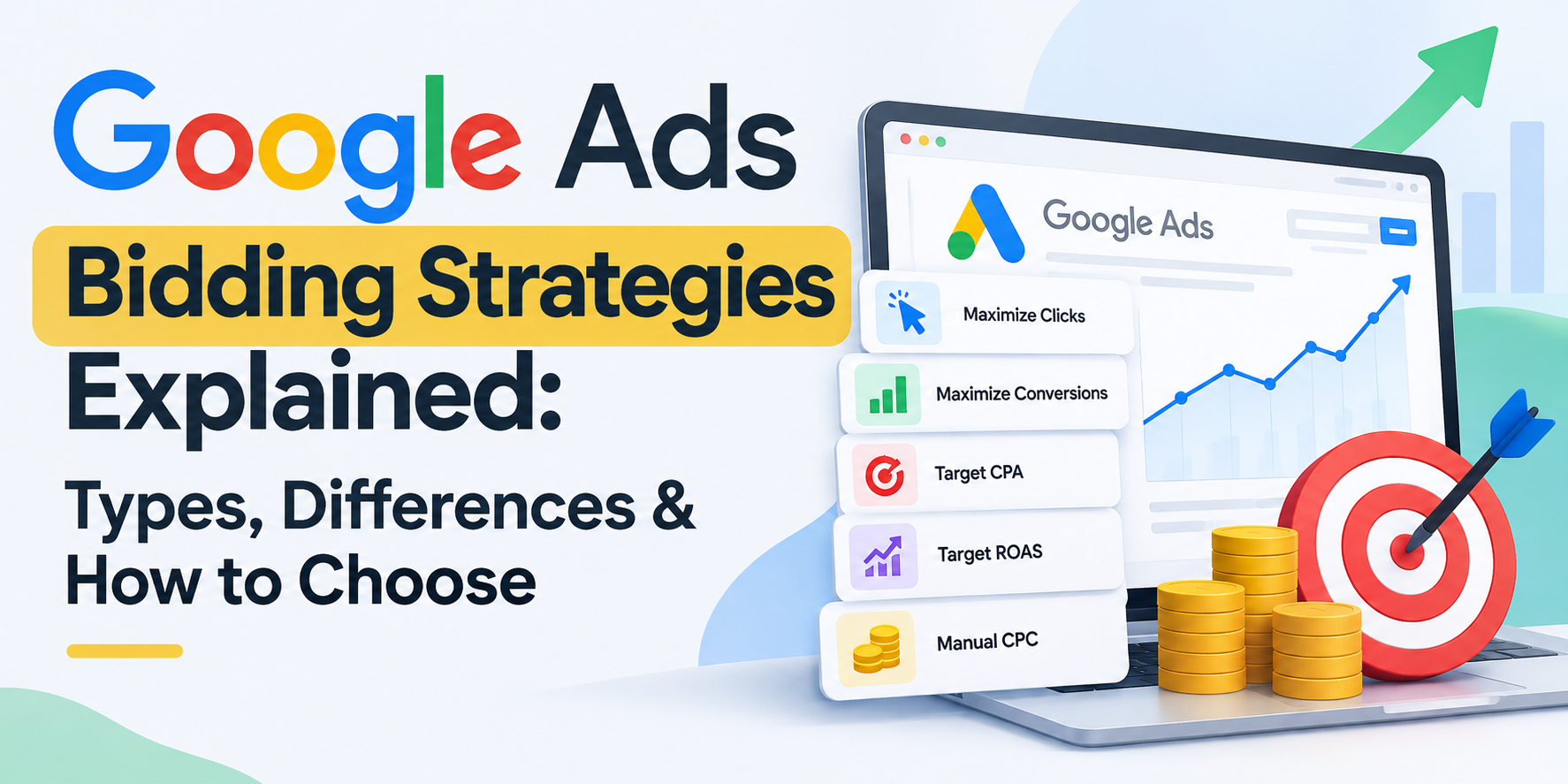
There is no single fixed number of Google Ads bidding strategies that applies to every advertiser. The options available depend on the campaign type, advertising objective and current Google Ads product support. Most advertisers will encounter Manual CPC, Maximize Clicks, Target Impression Share, Maximize Conversions, Target CPA, Maximize Conversion Value and Target ROAS, while impression, video and campaign-specific bidding methods add further options.
A more useful way to understand Google Ads bidding is to classify strategies by what they optimize and who controls the bid. That separates manual bidding, automated bidding and Smart Bidding, then connects each strategy to goals such as traffic, visibility, conversion volume or conversion value.
What Is a Bidding Strategy in Google Ads?
A bidding strategy tells Google Ads how bids should be set and which outcome the campaign should prioritize. Depending on the strategy, that outcome may be clicks, visibility, conversions, conversion value, video views or another campaign-specific objective.
A bid influences how much you are prepared to compete in an eligible ad auction. With Manual CPC, you directly set a maximum CPC bid. With automated bidding, Google sets or adjusts bids according to the selected strategy and the campaign's optimization goal.
The budget is a separate control. Your budget determines the amount available for campaign spending, while the bidding strategy determines how that spending competes across eligible auctions. Changing a budget does not automatically change the campaign's optimization objective, and changing a bidding target is not the same as changing the budget.
Manual, Automated and Smart Bidding Are Not the Same Thing
The first distinction to get right is the relationship between manual bidding, automated bidding and Smart Bidding. These terms describe different levels or types of bid control, and treating them as interchangeable creates confusion later.
Manual Bidding
With Manual Bidding, the advertiser directly controls the bid amount. Manual CPC is the main example: you can set maximum CPC bids at the level supported by the campaign, such as an ad group, keyword or placement.
Manual control does not mean Google Ads performs no automation anywhere in the campaign. It means the core bidding strategy is not automatically setting each auction bid around a conversion or value objective.
Automated Bidding
Automated Bidding means Google sets bids according to the objective of the selected strategy. Maximize Clicks can adjust bids to pursue click volume, while Target Impression Share sets bids around a visibility objective.
Automated bidding is therefore broader than conversion optimization. A strategy can be automated even when its primary objective is traffic, impressions or another non-conversion outcome.
Smart Bidding
Smart Bidding is a subset of automated bidding. Google currently uses the term for auction-time bidding strategies that optimize for conversions or conversion value.
The four core Smart Bidding strategies are Maximize Conversions, Target CPA, Maximize Conversion Value and Target ROAS. Maximize Clicks and Target Impression Share are automated bidding strategies, but they are not Smart Bidding strategies.
Google Ads Bidding Strategies at a Glance
The fastest way to narrow the options is to start with the outcome you actually want the campaign to optimize. The table below is a goal-to-strategy map, not a claim that every strategy is available for every campaign type.
| Primary Goal | Strategy to Understand | What It Optimizes | Important Caveat |
|---|---|---|---|
| Direct bid control | Manual CPC | Advertiser-controlled maximum CPC | Availability depends on campaign type |
| Website traffic | Maximize Clicks | Click volume within available budget | Does not optimize directly for conversions |
| Search visibility | Target Impression Share | Eligible Search impression share and placement goal | Primarily a Search visibility strategy |
| Conversion volume | Maximize Conversions | Total conversions | Requires trustworthy conversion measurement |
| CPA efficiency | Target CPA | Conversions around an average CPA target | Target CPA is not a hard per-conversion cap |
| Conversion value | Maximize Conversion Value | Total reported conversion value | Conversion values must represent meaningful business value |
| ROAS efficiency | Target ROAS | Conversion value around a ROAS target | The target is not a guaranteed return |
| Awareness | CPM, Target CPM or Viewable CPM | Impressions or viewable impressions | Campaign-specific availability applies |
| Video views | CPV or Target CPV | Video views or interactions | Relevant to supported Video objectives |
| Campaign-specific click objective | Target CPC | Clicks around an average CPC target | Current support is specific to eligible Demand Gen campaigns |
Availability varies by campaign type. A strategy that exists in Google Ads does not automatically appear in every Search, Shopping, Performance Max, Display, Video, Demand Gen or App campaign.
Manual CPC: When You Set the Maximum Bid Yourself
Manual CPC lets you directly set the maximum CPC you are prepared to bid for a click. This gives you direct bid control rather than asking Google to set auction bids around a conversion, CPA, ROAS or value objective.
That control can be useful when you have a specific reason to manage bids at a granular level, want to observe how different keywords or placements behave, or need a bidding method that does not depend on conversion-based optimization. Manual CPC is commonly associated with campaign structures such as Google Search Ads, although support still depends on campaign settings and type.
The trade-off is that manually chosen maximum bids cannot evaluate every auction around predicted conversion value in the way Smart Bidding can. That does not make Manual CPC universally inferior, and it does not make it a mandatory starting point for new campaigns.
For a traffic objective, the practical comparison is often Manual CPC versus Maximize Clicks. Manual CPC gives the advertiser bid control. Maximize Clicks gives Google control of bid setting around the objective of generating more clicks within the available budget.
Traffic, Visibility and View-Based Bidding Strategies
Not every campaign should optimize for conversions. Google Ads also provides bidding methods designed around traffic, Search visibility, impressions and video views. These strategies should be evaluated according to the outcome they pursue rather than mixed into the Smart Bidding category.
Maximize Clicks
Maximize Clicks is an automated strategy designed to generate as many clicks as possible within the campaign's available budget. Google sets CPC bids rather than requiring you to choose an individual bid for every eligible auction.
This makes the strategy relevant when website traffic itself is the immediate campaign objective. It should not be evaluated as though its primary task were to hit a CPA or ROAS target. A campaign can generate more clicks while still producing poor conversion economics if traffic quality or the conversion path is weak.
Target Impression Share
Target Impression Share is built around Search visibility rather than conversion efficiency. It allows eligible Search campaigns to pursue an impression-share objective with a selected placement goal, such as appearing anywhere on the Search results page, toward the top or at the absolute top.
The strategy makes more sense when visibility is itself a meaningful objective. It should not be interpreted as a direct instruction to generate conversions at a specific CPA.
CPM, Target CPM and Viewable CPM
CPM-based bidding focuses on impressions or awareness rather than clicks or conversions. Depending on the campaign and objective, Google Ads can use CPM variants such as Target CPM or viewable CPM.
These methods are campaign-specific. For example, viewable-impression bidding can be relevant to Google Display Ads, while Target CPM is used with supported video reach objectives. They should not be presented as universal bidding options across Google Ads.
CPV, Target CPV and Target CPC
CPV-based bidding is associated with supported video objectives where views or video interactions matter. If video consumption is the actual campaign goal, the relevant bidding logic can be different from a conversion campaign. The wider context belongs with YouTube Ads rather than a conversion-bidding comparison.
Target CPC is another campaign-specific automated strategy. In the current product, it is used in supported Demand Gen campaigns to pursue clicks around an average CPC target. It should not be treated as a replacement for Manual CPC across all campaign types.
The Four Google Ads Smart Bidding Strategies
Google currently identifies four core Smart Bidding strategies: Maximize Conversions, Target CPA, Maximize Conversion Value and Target ROAS. The first two focus on conversion volume. The other two focus on conversion value.
All four use auction-time bidding, but their optimization instructions differ. That difference matters more than repeatedly stating that the system uses automation.
Maximize Conversions
Maximize Conversions asks Google Ads to generate as many measured conversions as possible using the available budget. The optimization objective is conversion volume rather than the value of each individual conversion.
This direction can make sense when the conversions included in the campaign's bidding goals are genuinely useful and are reasonably similar in business importance. A lead-generation campaign, for example, may prioritize the number of qualified lead actions if those actions are consistently defined and measured.
The strategy depends on the conversion actions being meaningful. If low-value actions are treated as primary conversions alongside genuine sales or qualified leads, increasing the number of recorded conversions can move bidding toward the wrong business outcome.
Target CPA
Target CPA also optimizes for conversion volume, but it adds a cost-per-acquisition objective. Google sets bids with the intention of generating as many conversions as possible around the average CPA target you provide.
The word "target" matters. Individual conversions can cost more or less than the selected Target CPA. It is an average optimization objective, not a maximum amount that every conversion is prevented from exceeding.
A very restrictive target can reduce the auctions that the bidding system considers economically suitable, which may limit conversion volume. Lowering a Target CPA therefore does not mechanically guarantee a lower actual CPA with unchanged volume.
If your issue is rising acquisition cost, changing the target should not be the only diagnostic step. Traffic mix, conversion rate, competition, landing-page performance and measurement can also affect CPA. I cover that wider diagnostic problem in the guide on how to reduce CPA.
Maximize Conversion Value
Maximize Conversion Value tells Google Ads to pursue the greatest total reported conversion value within the available budget. This changes the optimization problem because one conversion can matter more than another.
For ecommerce, the conversion value may represent transaction revenue or another properly configured business value. For lead generation, different qualified outcomes can also be assigned different values when the business has enough evidence to make those values meaningful.
The bidding system can only optimize the values it receives. If every lead is given the same arbitrary value even though some outcomes are far more valuable, the bidding input does not communicate that difference.
Target ROAS
Target ROAS combines conversion-value optimization with a return objective. Google attempts to generate conversion value while operating around the return-on-ad-spend target supplied by the advertiser.
Target ROAS is not a guaranteed financial return. Actual performance can move above or below the selected target, and the strategy optimizes against the conversion values available inside Google Ads. Reported conversion value is also not automatically the same as gross profit or contribution margin.
A stricter ROAS target can narrow the opportunities the system is willing to pursue. Before treating the target as the cause of weak performance, confirm that conversion values, budget, campaign structure and the economic target itself make sense. The separate guide on how to improve ROAS covers that wider performance problem.
| Strategy | Optimizes For | Uses Efficiency Target | Requires Meaningful Conversion Value |
|---|---|---|---|
| Maximize Conversions | Conversion volume | No CPA target | No, if conversions can reasonably be treated equally |
| Target CPA | Conversion volume | Yes, average CPA target | No, if conversions can reasonably be treated equally |
| Maximize Conversion Value | Total conversion value | No ROAS target | Yes |
| Target ROAS | Conversion value | Yes, ROAS target | Yes |
Conversion-Based vs Value-Based Bidding
Conversion-based bidding prioritizes the number of measured outcomes. Value-based bidding prioritizes the reported business value of those outcomes. The difference becomes important when two conversions should not be treated as economically equal.
Conversion-Volume Bidding
Maximize Conversions and Target CPA belong to the conversion-volume side of the decision. Suppose a lead-generation campaign has one primary conversion that represents a qualified consultation request and each qualified request is treated similarly by the business. Optimizing the number of those outcomes can be a reasonable model.
Value-Based Bidding
Maximize Conversion Value and Target ROAS become more relevant when conversions carry meaningfully different values. Consider a hypothetical ecommerce store where one order is worth ₹2,000 and another is worth ₹20,000. Counting both merely as one conversion removes information that value-based bidding can use.
Lead-generation businesses can also use value-based bidding when they can reliably differentiate the expected business value of different conversion outcomes. The requirement is not "ecommerce." The requirement is accurate conversion values that communicate real differences in business value.
| Factor | Conversion-Based | Value-Based |
|---|---|---|
| Primary outcome | Number of conversions | Total reported conversion value |
| Relevant strategies | Maximize Conversions, Target CPA | Maximize Conversion Value, Target ROAS |
| Better conceptual fit | Outcomes are similar in value | Outcomes have meaningful value differences |
| Measurement dependency | Reliable primary conversion actions | Reliable conversions plus accurate values |
Before moving toward value-based bidding, check whether the values being sent to Google Ads represent the outcome you actually want to optimize. A sophisticated bidding strategy cannot correct fundamentally misleading measurement inputs.
Maximize vs Target: What Changes When You Add an Efficiency Goal?
A maximize strategy asks what conversion volume or conversion value the available budget can produce. A target strategy adds an efficiency objective such as CPA or ROAS. The target changes the bidding instruction, but it is not a guarantee that every individual outcome will meet the selected number.
Maximize Conversions vs Target CPA
Maximize Conversions prioritizes total conversion volume within the available budget. Target CPA still pursues conversions, but it asks the system to operate around an average cost-per-acquisition objective.
If the CPA target is materially tighter than the opportunities available in the current auctions, the system may reduce participation in auctions that appear unlikely to meet that objective. The possible trade-off is less conversion volume. Raising or lowering a target should therefore be treated as a change in the campaign's efficiency instruction, not as a guaranteed way to improve performance.
Maximize Conversion Value vs Target ROAS
Maximize Conversion Value pursues total reported conversion value within the budget. Target ROAS adds a return objective and asks the bidding system to balance value generation against that target.
A higher ROAS target can make bidding more selective. That may reduce the amount of traffic or conversion value the campaign can capture if fewer auctions are expected to satisfy the target. Higher Target ROAS does not automatically mean higher profit because Google Ads is optimizing the conversion values supplied to it, not your full profit-and-loss statement.
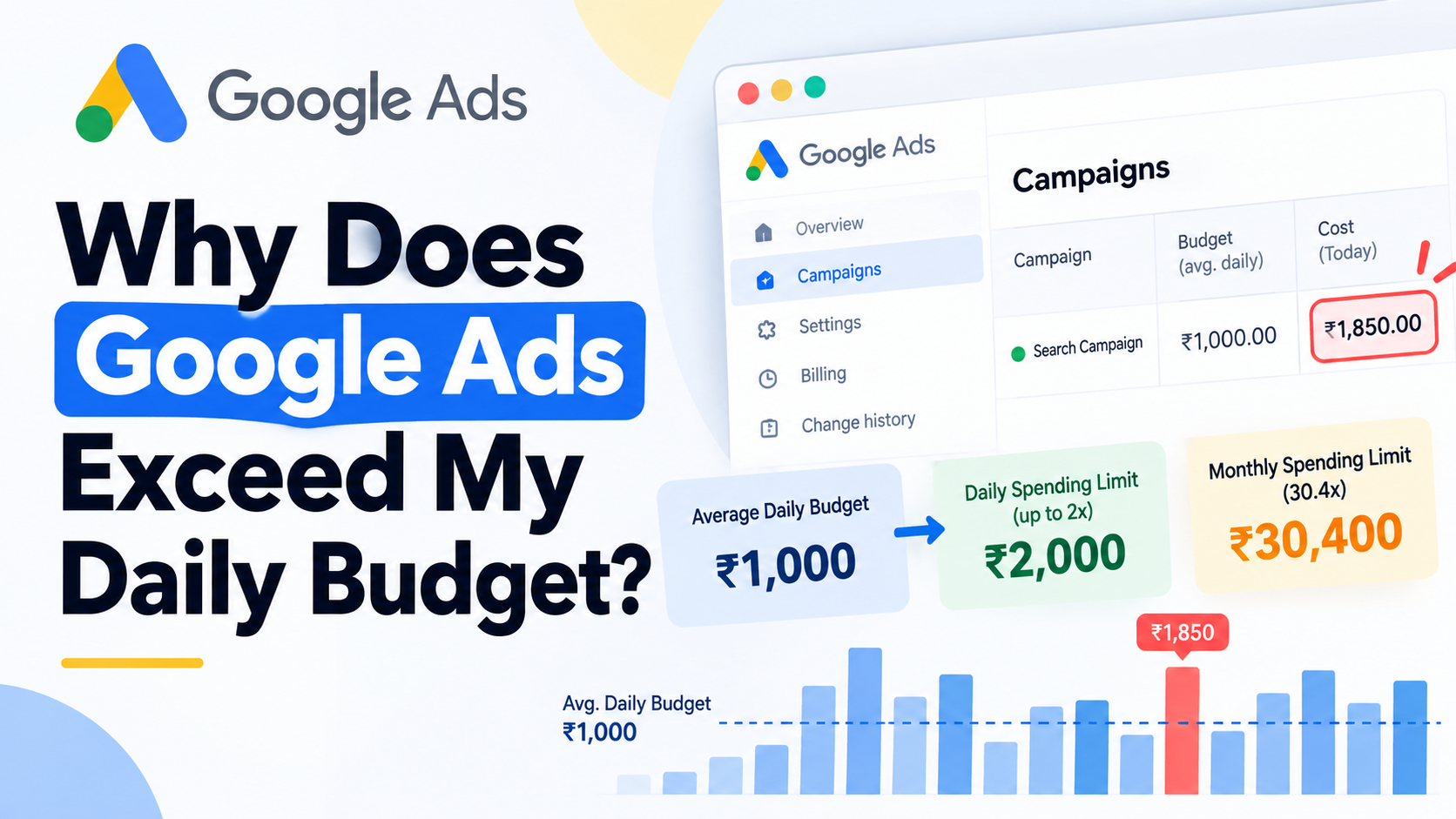
The budget and the bid target perform different jobs. Budget controls spend capacity. CPA and ROAS targets influence the efficiency objective. This distinction also matters when interpreting why Google Ads can exceed the daily budget on an individual day.
Standard vs Portfolio Bid Strategies
Standard and portfolio describe the application scope of a supported bidding strategy. They are not separate objectives competing with CPA, ROAS, conversions or clicks.
A standard strategy is applied to one campaign. A portfolio strategy can apply a supported strategy across multiple campaigns from the account-level bid-strategy layer. Portfolio support varies by strategy and campaign type, so the availability of a bidding objective does not automatically mean it can be deployed as a portfolio strategy.
| Factor | Standard | Portfolio |
|---|---|---|
| Application scope | Single campaign | Multiple campaigns where supported |
| Optimization objective | Defined by the selected bid strategy | Defined by the selected bid strategy |
| Separate bidding objective? | No | No |
| Main distinction | Campaign-level application | Cross-campaign application |
Portfolio bidding should therefore be evaluated as an account-structure decision after the bidding objective has been chosen, not as an alternative to deciding whether you want clicks, conversions, CPA efficiency or conversion value.
Which Bidding Strategies Are Available by Campaign Type?
Strategy availability varies by campaign type, campaign objective and current Google Ads product support. The matrix below was reviewed against current Google documentation on October 1, 2026. "Limited" means availability can depend on subtype, objective, eligibility or a specific Google Ads implementation.
| Strategy | Search | Shopping | Performance Max | Display | Video | Demand Gen | App |
|---|---|---|---|---|---|---|---|
| Manual CPC | Yes | Yes | No | Yes | No | No | No |
| Maximize Clicks | Yes | Yes | No | Yes | No | Yes | No |
| Target Impression Share | Yes | No | No | No | No | No | No |
| Maximize Conversions | Yes | No for standard Shopping | Yes | Yes | Yes | Yes | Yes |
| Target CPA | Yes | No for standard Shopping | Yes | Yes | Yes | Yes | Yes |
| Maximize Conversion Value | Yes | Yes | Yes | Limited | Yes | Yes | Yes |
| Target ROAS | Yes | Yes | Yes | Yes in supported contexts | Yes in supported contexts | Yes | Yes with eligibility requirements |
| Viewable CPM | No | No | No | Yes | Available for supported video formats | No | No |
| Target CPM or CPV family | No | No | No | No | Yes for supported objectives | No | No |
| Target CPC | No | No | No | No | No | Yes | No |
The table should be treated as a current compatibility guide, not permanent product documentation. Google can change campaign support, eligibility and interface options.
For campaign-specific implementation questions, use the dedicated pages for Google Shopping Ads and Performance Max rather than assuming the same bidding options apply across campaign types.
How to Choose a Google Ads Bidding Strategy by Business Goal
There is no universal bidding strategy that is the right choice for every Google Ads campaign. The more useful decision is to match the business outcome, measurement quality, value structure, efficiency requirement and campaign compatibility to the appropriate bidding direction.
- Define the primary outcome. Decide whether the campaign should prioritize direct bid control, traffic, visibility, conversion volume or conversion value.
- Check whether that outcome is measured reliably. Conversion-based automation becomes difficult to evaluate when primary conversion actions are incomplete, duplicated or commercially irrelevant.
- Determine whether conversions have different business values. If they do, conversion-value bidding may represent the business objective more accurately than conversion-count bidding.
- Decide whether an efficiency target is economically meaningful. A CPA or ROAS target should reflect what the business can sustain rather than an arbitrary number chosen to make the dashboard look better.
- Confirm campaign compatibility. The strategy must actually be supported by the campaign type, objective and current Google Ads product configuration.
If the objective is traffic, Maximize Clicks or direct CPC control may deserve evaluation. If conversions are the outcome and they carry similar value, the decision moves toward Maximize Conversions or Target CPA. If conversion values differ materially, Maximize Conversion Value or Target ROAS becomes more relevant.
Campaign age alone should not decide the strategy. A new campaign does not automatically require Manual CPC, and an established ecommerce campaign does not automatically require Target ROAS. The decision depends on what the campaign is expected to achieve and whether the available measurement can support that instruction.
If bidding appears to be the problem but the account is missing conversions, spending on the wrong searches or losing users after the click, changing the strategy can hide the actual issue. Use the broader diagnostic framework for why Google Ads are not working before treating bidding as the only cause.
Does Smart Bidding Need a Minimum Number of Conversions?
Do not treat 15, 30 or 50 conversions as a universal Google requirement for Target CPA. Current Google documentation states that Target CPA can be used with no conversion history in supported contexts. At the same time, Google publishes campaign-specific recommendations and eligibility requirements for some strategies and campaign types.
Eligibility
Eligibility asks whether Google Ads allows the strategy to be used in that campaign and configuration. It is a product-support question. Eligibility can depend on campaign type, conversion configuration and, for some strategies, specific historical-data requirements.
Readiness
Readiness is a different question. A campaign can technically qualify for a strategy while still giving the bidding system weak or misleading information.
- Reliable conversion tracking
- Meaningful primary conversion actions
- Conversion signals that represent the actual business goal
- A realistic CPA or ROAS target when a target strategy is used
- A campaign structure stable enough to evaluate
- Enough budget and traffic to generate useful evidence
- Accurate conversion values for value-based bidding
There is also a third issue: evaluation confidence. More relevant conversion history can make it easier to judge performance, even when that history is not a universal technical prerequisite. This is why a recommendation about data volume should not automatically be rewritten as a platform eligibility rule.
If the measurement itself is unreliable, fix conversion tracking before drawing strong conclusions about whether the bidding strategy is failing.
What Changed With Google Ads Bidding in 2026?
Two dated Google Ads bidding changes matter when reading older guides in 2026: a terminology change that started in June and a target-based bidding update for budget-limited campaigns that rolled out in August.
Target CPA and Target ROAS Labels Changed
Starting in June 2026, Google changed how two Smart Bidding configurations are labeled. "Maximize Conversions with a Target CPA" is presented as "Target CPA," while "Maximize Conversion Value with a Target ROAS" is presented as "Target ROAS."
The label update did not fundamentally change the underlying bidding behavior. This explains why older screenshots or documentation may show the longer maximize-with-target wording while current interfaces use the shorter Target CPA and Target ROAS names.
Target-Based Bidding Changed for Budget-Limited Campaigns
Google began rolling out updated target-based bidding behavior on August 17, 2026, and completed the global rollout on August 27, 2026. The update affects supported campaigns using Target CPA, Target ROAS and Target CPC for Demand Gen when those campaigns are in a "Limited by budget" state.
The purpose of the change is to make affected campaigns optimize more consistently toward the stated target even when the campaign is budget constrained. Google does not automatically change the advertiser's daily budget or bidding target as part of this update.
| Change | Before | Current | What Advertisers Should Understand |
|---|---|---|---|
| Smart Bidding labels | Maximize Conversions with Target CPA and Maximize Conversion Value with Target ROAS wording | Target CPA and Target ROAS labels from June 2026 | The naming changed without a fundamental change to the underlying bidding behavior |
| Budget-limited target behavior | Budget-constrained campaigns could behave differently relative to the stated target | Updated target-based behavior fully rolled out by August 27, 2026 | Review limited-by-budget campaigns and their targets, but Google does not automatically change the budget or target |
Is Enhanced CPC Still Available in Google Ads?
No. Enhanced CPC is retired as a current bidding option for Search and Display campaigns. Google states that Enhanced CPC was no longer available for those campaign types from the week of March 31, 2025.
Search and Display campaigns that had not been proactively migrated effectively moved to Manual CPC. Shopping had already moved away from Enhanced CPC earlier. Older articles, screenshots and reports may still mention eCPC, but it should not be inserted into a current list of active Google Ads bidding strategies.
Google Ads Bidding Strategy FAQs
How many bidding strategies are there in Google Ads?
There is no universal fixed count because bidding options vary by campaign type, objective and current product support. Core strategies include Manual CPC, Maximize Clicks, Target Impression Share and the four Smart Bidding strategies, with CPM, CPV, Target CPC and other campaign-specific options expanding the list in relevant contexts.
What are the four Smart Bidding strategies?
The four core Google Ads Smart Bidding strategies are Maximize Conversions, Target CPA, Maximize Conversion Value and Target ROAS. Maximize Conversions and Target CPA optimize conversion volume, while Maximize Conversion Value and Target ROAS optimize conversion value.
Is Smart Bidding the same as automated bidding?
No. Smart Bidding is a subset of automated bidding focused on conversions or conversion value using auction-time bidding. Maximize Clicks and Target Impression Share are automated strategies, but Google does not classify them as Smart Bidding strategies.
Which bidding strategy is best for Google Ads?
There is no universal best strategy. Choose the bidding direction according to the campaign's business goal, measurement quality, whether conversions differ in value, whether an efficiency target is meaningful, and which strategies are supported by the campaign type.
What is the difference between Maximize Conversions and Target CPA?
Maximize Conversions attempts to generate the most conversions within the available budget. Target CPA adds an average cost-per-acquisition objective. A restrictive CPA target can reduce available conversion volume, and the selected target does not cap the cost of every individual conversion.
What is the difference between Maximize Conversion Value and Target ROAS?
Maximize Conversion Value pursues the greatest total reported conversion value within the budget. Target ROAS adds a return objective and asks Google Ads to pursue conversion value around that target. The ROAS target is an optimization objective rather than a guaranteed financial result.
Does Target CPA require 30 conversions?
No universal rule requires every Target CPA campaign to reach 30 conversions before the strategy can be used. Google currently states that Target CPA can start with no conversion history in supported contexts. Campaign-specific recommendations, eligibility conditions and the amount of data needed for confident evaluation can still vary.
Is Target CPA a maximum cost per conversion?
No. Target CPA represents the average CPA the bidding strategy attempts to work around. Individual conversions can cost more or less than the target because actual auction conditions, conversion rates and available opportunities vary.
Does Target ROAS guarantee the selected ROAS?
No. Target ROAS tells Google Ads what average return objective to optimize toward. Actual ROAS can vary according to auction opportunities, budget, competition, conversion values, conversion rates and other campaign conditions.
Is Enhanced CPC still available in Google Ads?
Enhanced CPC is no longer available for Search and Display campaigns. Google retired it from the week of March 31, 2025, and affected campaigns that were not migrated effectively use Manual CPC.
What is a portfolio bidding strategy?
A portfolio strategy applies a supported bidding strategy across multiple campaigns. It describes application scope rather than a new optimization objective. Portfolio availability depends on the bidding strategy and campaign type being used.
Should a new Google Ads campaign start with Manual CPC?
Not automatically. A new campaign's starting strategy should follow its objective, available measurement, campaign type and data quality. Manual CPC can be suitable when direct bid control matters, while automated strategies can also be appropriate when the campaign has a clear optimization goal and trustworthy inputs.
Choose the Objective Before the Bidding Strategy
Choose the objective before the bidding strategy. Decide what business outcome the campaign should produce, verify measurement, confirm campaign compatibility, then decide whether the campaign should maximize volume or value or operate around an efficiency target.
If performance is weak, do not assume bidding is automatically the root cause. Review the wider reasons Google Ads may not be working before making strategy changes in isolation.
If the campaign has multiple interacting problems and you need help separating bidding, measurement, traffic quality and conversion issues, you can contact Vijay to discuss the account context.