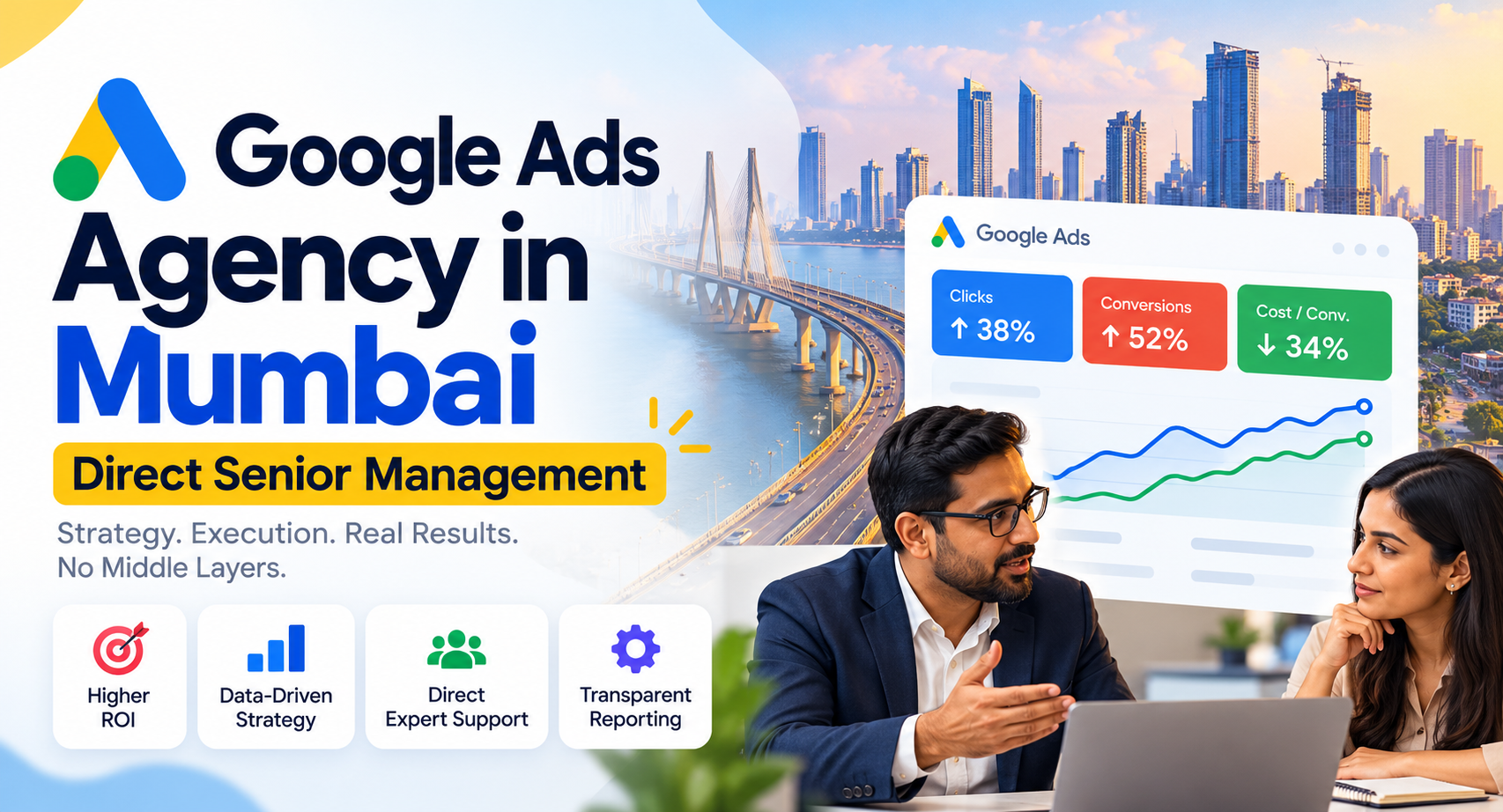
If you are comparing a Google Ads agency in Mumbai, the important question is not only where the provider's office is located. You also need to know who will manage the account, who owns the advertising data, how qualified leads or sales are measured, what happens to your billing, and whether the person making decisions understands your business model.
VijayBhabhor provides Google Ads management for Mumbai businesses remotely from Surat, Gujarat. I do not operate a Mumbai office, and this page does not imply otherwise. The working model is built around direct senior involvement, client-owned Google Ads accounts, media paid directly to Google, and campaign decisions connected with commercial outcomes rather than clicks alone.
This page is designed to help a Mumbai business decide whether that operating model fits, what Google Ads management should include, how local-service, B2B and ecommerce requirements differ, what current 2026 capability looks like, and what to verify before hiring a provider.
Can VijayBhabhor Manage Google Ads for Mumbai Businesses From Surat?
Yes. Google Ads accounts can be managed remotely, and I work with Mumbai businesses from Surat, Gujarat. The business can retain its own account, billing and data while campaign management, measurement review, optimisation and strategic decisions are handled remotely.
For most Google Ads engagements, the quality of management depends more on access, communication, measurement, decision-making and market understanding than on whether the person managing the account sits in the same city as the advertiser.
That does not make location irrelevant. A Mumbai local-service company may care deeply about where its customers are physically located. A Mumbai B2B company may sell across India. An ecommerce business headquartered in Mumbai may advertise nationally or internationally. The provider needs to understand the customer market even when campaign management itself is remote.
You can see the wider range of Google Ads services if your requirement extends beyond ongoing Mumbai account management.
Do You Need a Google Ads Agency Physically Based in Mumbai?
No, not automatically. A physical Mumbai office mainly changes meeting logistics. It does not determine whether search terms are reviewed correctly, conversions are reliable, budgets are allocated well or qualified leads become customers.
A local office may matter when frequent face-to-face collaboration is part of your operating model. If campaign work, reporting, account reviews and strategic discussions can happen remotely, the stronger hiring criteria are who actually handles the account, whether they understand the target market and whether responsibilities are clear.
The provider should simply be transparent about where they are based. In this case, the service is delivered from Surat for businesses advertising in Mumbai and other markets.
What Should Google Ads Management for a Mumbai Business Actually Include?
Google Ads management should connect your business objective with the campaigns, conversion signals, budgets and decisions needed to reach that objective. It should not be reduced to adding keywords, changing bids and sending a monthly dashboard.
The exact scope depends on the business, but ongoing management can involve Search campaigns, Performance Max, Shopping, Merchant Center, conversion tracking, search terms, negative keywords, bidding, budget allocation, ad assets, product data, landing-page constraints, testing and reporting.
Those activities should not run independently. For example, increasing a budget makes little sense if conversion tracking is unreliable. Changing a bidding target can create the wrong outcome if the account is optimising for low-quality form submissions. An ecommerce campaign cannot be evaluated only from ad settings if Merchant Center data or product economics are the real constraint.
The complete operating scope, plans and responsibilities are covered on the Google Ads management services page. This Mumbai page focuses on whether that service model fits a Mumbai business.
What Should a Google Ads Manager Do Beyond Keywords and Bid Changes?
A modern management process should start with the result the business needs and work backwards.
That means understanding:
- which products, services or customer segments matter commercially;
- which campaigns are responsible for capturing that demand;
- whether conversion actions represent real business value;
- how budgets should be distributed across opportunities;
- which bidding approach fits the available data and objective;
- whether landing pages, product feeds or Merchant Center limit performance;
- which tests should happen next;
- and what the resulting data changes about the next decision.
A list of campaign types is not a management strategy. Before hiring a provider, ask what decisions they expect to own and what inputs they will need from your business.
How Should a Google Ads Provider Measure Performance Beyond Clicks and Raw Leads?
Google Ads performance should be measured as close to real business value as your systems allow. For lead generation, that means moving from raw forms or calls toward qualified leads, opportunities and customers. For ecommerce, it means looking beyond reported revenue into customer acquisition cost, margin, product economics and profitable growth where the data supports it.
CTR, CPC and Quality Score are useful diagnostic signals. They are not the final business result.
| Stage | What It Means | Use in Reporting |
|---|---|---|
| Click | A user visited after interacting with an ad | Useful for traffic and cost diagnostics |
| Lead | A form, call or another enquiry was generated | Shows response volume but not necessarily quality |
| Qualified lead | The enquiry matches the service, market and buying criteria | Better measure for lead-generation optimisation |
| Opportunity or customer | The lead progressed into pipeline, revenue or a completed sale | Closest connection to commercial value |
Why Can a Lower CPL Still Produce Worse Business Results?
Because the cheapest lead is not necessarily the most valuable lead.
Consider a hypothetical comparison. Campaign A generates 100 forms at a lower CPL, but only 10 qualify for the sales team. Campaign B generates 60 forms at a higher CPL, but 30 are qualified opportunities.
If you report only form CPL, Campaign A appears stronger. Once qualification is included, Campaign B may be creating substantially more commercial value.
This is particularly important for businesses where sales teams spend time calling, qualifying and following up. Cheap but irrelevant enquiries can consume sales capacity and make the marketing dashboard look healthier than the business outcome actually is.
The same principle applies to ROAS. A higher platform ROAS is useful, but margin, repeat purchasing, product mix and acquisition cost still determine whether that revenue is attractive to the business.
How Can Google Ads Learn From Qualified Leads, CRM Data and Offline Outcomes?
When a business has the systems to record what happens after an online enquiry, those deeper outcomes can improve Google Ads measurement.
Enhanced conversions for leads can use appropriately handled first-party lead information to improve attribution between an ad interaction and a later offline outcome. A business using a CRM may be able to distinguish a submitted form from a qualified opportunity or completed customer action and send supported outcomes back into the measurement process.
Google also changed enhanced-conversion workflows during 2026, including more unified settings and Data Manager oriented workflows for newer offline conversion connections.
You do not need a complicated CRM integration in every account. You do need a provider who understands that a raw conversion event is only useful if it represents something the business actually values.
Should a Google Ads Agency Own Your Account, Billing or Data?
No. Your business should retain appropriate ownership and access to its Google Ads account, data and billing visibility. The provider can manage campaigns through user access or a linked Google Ads Manager Account without requiring the advertiser to surrender the underlying advertising asset.
This matters because your Google Ads account contains campaign history, conversion data, search-term information, audience signals, experiments and years of optimisation decisions. Changing providers should not mean starting again simply because the previous agency controlled access.
How Should Manager Account Access Work Without Giving Up Ownership?
A Google Ads Manager Account can be linked to an existing client account so the provider can manage campaigns while the client continues to access its own account.
Google's current account model allows administrators of the client account to continue signing in and using the account after a manager is linked. An administrator can also terminate the manager relationship by unlinking it.
A practical operating model looks like this:
- your business retains administrative access;
- your Google Ads account and history remain associated with the business;
- the management provider receives the access required to perform the agreed work;
- relevant analytics, Merchant Center or tracking permissions are granted separately where needed;
- access can be changed or removed during handover.
The principle is simple: management access should enable the work without creating unnecessary dependence on the provider.
What Should Happen to Billing, Access and Data When the Engagement Ends?
The account should remain usable by the business, and access should be easy to review during handover.
Under the current VijayBhabhor management model, Google Ads media spend is paid directly to Google while the management fee is billed separately. That keeps media and service charges distinct.
If the engagement ends, the business should know which users and manager accounts are connected, which tracking or reporting systems were used, which changes are still in progress and what the next manager needs to understand.
Before hiring any Google Ads provider, ask how account ownership, billing and handover work before you sign, not after you decide to leave.
How Should Google Ads Strategy Differ for Local Services, B2B and Ecommerce Businesses in Mumbai?
The strategy should follow how the business earns revenue and where its actual customers are located. A Mumbai address does not automatically mean every campaign should target only Mumbai.
| Business Model | Primary Demand | Targeting Logic | Primary Outcome |
|---|---|---|---|
| Local service | High-intent local searches | Mumbai, selected service areas or appropriate parts of the MMR | Qualified calls, forms, appointments or enquiries |
| B2B | Commercial searches from target buyers | Buyer geography, which may extend beyond Mumbai | Qualified lead, opportunity or pipeline value |
| Ecommerce | Product and category demand | Markets where the business can profitably sell and fulfil | Orders, CAC, revenue and commercially useful ROAS |
How Should a Mumbai Local-Service Business Target Its Service Area?
A local-service business should target the areas it can realistically serve, rather than using Mumbai simply because the company is located there.
A clinic, home service provider, professional practice or location-dependent business may need campaigns focused tightly on Mumbai or selected parts of the Mumbai Metropolitan Region. Navi Mumbai and Thane should only be included when the business can genuinely serve those users.
Google's advanced location options also matter. The default Presence or Interest option can include users who are in, regularly in, or have shown interest in a target location. Presence focuses more narrowly on users in or regularly in that location.
Neither setting should be applied blindly. Review the business objective, actual customer locations and lead quality. Google location targeting also relies on signals and should not be treated as perfectly precise.
Should a Mumbai B2B Company Target Only Mumbai?
Not if its buyers are located elsewhere.
A B2B software company, manufacturer, professional service provider or exporter may have its office in Mumbai while selling across India or internationally. In that case, the customer market should define geography.
For B2B accounts, the more important measurement question is often whether enquiries become qualified pipeline. CRM and offline lead feedback can therefore matter more than forcing every campaign into a Mumbai-only structure.
Company location and customer location are two different decisions.
What Should an Ecommerce Business Expect From a Google Ads Provider?
Ecommerce requires more than Search campaign management. Depending on the account, a provider may need to understand Merchant Center, Google Shopping, Performance Max, product feeds, landing pages and how product economics affect acquisition decisions.
ROAS also needs business context. Average order value, gross margin, new versus returning customers, product mix and allowable CAC can change whether the same reported ROAS is profitable.
The provider does not need to run every available Google campaign type. They should be able to explain why each campaign exists, what conversion signal it uses and how it fits the store's acquisition economics.
Which 2026 Google Ads Capabilities Should a Provider Serving Mumbai Understand?
A page can say "2026" while still describing a Google Ads operating model from several years ago. Current competence should show up in the concepts the provider understands and the recommendations they make.
Three useful freshness checks in 2026 are AI Max for Search, current enhanced-conversion and offline lead workflows, and the transition away from new call-only ads.
What Should a Google Ads Provider Know About AI Max for Search?
AI Max is not a separate Google Ads campaign type. Google describes it as an optimisation layer within existing Search campaigns.
Current AI Max controls can influence search-term matching, text customization and Final URL Expansion. A provider should therefore understand not only how to enable automation but also how conversion quality, landing pages, URL controls, messaging and reporting affect whether that automation is appropriate.
The useful hiring question is not, "Do you use AI?" Ask how the provider decides when more Search expansion is justified, what they monitor after enabling it and how they protect campaign intent.
Which Outdated Google Ads Practices Should Make You Question a Provider?
One easy example is call-only ads. Google removed the ability to create new call-only ads in February 2026 and directs advertisers toward Responsive Search Ads with call assets. Existing call-only ads are scheduled to stop receiving impressions in February 2027.
That does not mean a provider becomes unqualified because they use an old phrase in conversation. It does mean a current service proposal should reflect current platform behaviour.
The same applies to conversion tracking. Google's enhanced-conversion settings and offline lead workflows changed during 2026. A provider responsible for measurement should understand current workflows rather than automatically reproducing an implementation built around an older interface or API process.
Platform freshness is not about chasing every new feature. It is about making sure the advice you pay for still matches the platform you are using.
Do You Need Ongoing Google Ads Management, a Senior Expert or Broader Agency Support?
Choose the support model according to the responsibility you need someone to take. Do not buy ongoing management when your internal team already executes well and only needs senior direction. Do not hire a strategy-only expert if nobody has the capacity to implement the recommendations.
| Need | Best-Fit Model | Why |
|---|---|---|
| Continuous account operation | Ongoing Google Ads management | One external owner handles recurring campaign, budget, testing and reporting work |
| Internal execution plus senior direction | Google Ads expert | Your team implements while a senior specialist helps diagnose and guide decisions |
| You are still defining the requirement | Broader Google Ads service review | The first decision is determining whether you need management, expert support, consulting or another service |
When Is Ongoing Google Ads Management the Right Fit?
Ongoing management fits when your business wants an external provider to take continuing responsibility for the account rather than deliver a one-time review.
That can include recurring campaign operation, search-term control, budget decisions, testing, conversion review, reporting and ongoing optimisation. The exact campaign mix depends on the account.
The advantage is continuity. The same operating process observes what changed, what happened after the change and what should happen next.
When Is a Senior Google Ads Expert the Better Fit?
Senior expert support can be the better model when your company already has an internal marketer, PPC manager or agency capable of implementation but needs stronger diagnosis, strategy or specialist oversight.
In that situation, paying for a second full management layer may create unnecessary duplication. Direct access to a Google Ads expert can make more sense when the missing capability is senior judgement rather than daily account execution.
Before choosing, ask one question: who will implement the recommendations after the decision is made?
How Much Does Google Ads Management Cost for Mumbai Businesses?
There is no official Google Ads agency rate for Mumbai. Providers use different scopes, team structures and pricing models, so a city-wide "correct price" would be misleading.
For VijayBhabhor's current ongoing management service, published plans start at ₹25,000 per month with a minimum monthly Google Ads spend of ₹3 lakh. Advertising spend is separate and paid directly to Google.
The published management plans currently include:
- Starter: ₹25,000 per month at ₹3 lakh monthly ad spend;
- Growth: ₹35,000 per month for spend above ₹3 lakh through ₹5 lakh;
- Scale: flat ₹50,000 per month for monthly ad spend above ₹5 lakh.
Applicable taxes and separately scoped work are additional. Creative production, website development or other technical implementation should not be assumed to be included unless explicitly agreed.
Should You Choose a Google Ads Provider Based on the Lowest Monthly Fee?
No. Compare the responsibility behind the fee.
A lower management fee may represent a smaller scope, less senior involvement, limited measurement work or fewer implementation responsibilities. A higher fee does not prove quality either.
Before comparing prices, normalize what you are buying:
- Who manages the account?
- Is measurement review included?
- Are Shopping and Merchant Center included when relevant?
- Who handles landing-page or feed dependencies?
- How often is performance reviewed?
- How are qualified outcomes reported?
- Who owns the advertising account?
Only then are two service fees genuinely comparable.
What Should the First 30 to 90 Days With a Google Ads Provider Look Like?
The first 30 to 90 days should establish how the account will be managed, not promise a predetermined performance result by a fixed date.
The sequence depends on whether the account is new, mature, misconfigured, under-measured or already performing well. A new manager should understand the business and data before making large structural changes merely to demonstrate activity.
| Phase | Primary Focus | Output |
|---|---|---|
| Start | Business goals, target markets and account context | Clear commercial priorities and responsibilities |
| Measurement and access | Account permissions and conversion reliability | Confidence in the data used for decisions |
| Build or repair | Campaign priorities and material constraints | Prioritised implementation plan |
| Testing | Search demand, bidding, creative, product or landing-page hypotheses | Evidence for the next decision |
| Reporting and decisions | Qualified outcomes, budget pacing and significant changes | Clear view of what changed and what happens next |
What Should Happen Before Major Changes Are Made to Your Google Ads Account?
First confirm access, business goals, target markets and conversion definitions. Then identify any urgent account risks before restructuring campaigns.
An inherited account may contain years of useful history. Existing Search campaigns, conversion data, negative keywords, experiments or product segmentation should not be discarded simply because a new provider prefers a different naming convention.
The provider should be able to explain what needs to change, what should remain stable and what evidence supports that decision.
What Should Ongoing Google Ads Reporting Tell You?
Reporting should tell you what happened, why it matters and what decision follows.
A useful report can include qualified outcomes, budget pacing, major account changes, meaningful campaign observations, commercial constraints and the next test or decision.
A dashboard full of impressions, CTR, CPC and conversions can still leave a business owner unable to answer the important question: is our Google Ads investment producing the kind of customers we actually want?
Reporting should reduce that uncertainty rather than add another layer of metrics.
How Should You Compare Google Ads Agencies and Experts Serving Mumbai?
Compare providers using operating facts rather than self-awarded labels such as "best Google Ads agency in Mumbai."
The strongest comparison points are who will actually work on the account, account ownership, measurement quality, fit with your business model, current platform knowledge, pricing transparency, reporting and handover.
| Criterion | What to Verify | Red Flag |
|---|---|---|
| Who works on the account | Named strategist or manager and level of senior involvement | The senior person disappears after the sales call |
| Ownership | Your business retains account and data access | Provider blocks admin access or controls the only account |
| Measurement | Qualified leads, sales or business outcomes where systems permit | Success is discussed only through clicks or raw forms |
| Business-model fit | Strategy changes for local service, B2B and ecommerce | Same campaign plan is proposed for every business |
| 2026 competence | Current Search automation, call assets and measurement knowledge | Proposal relies heavily on outdated call-only or legacy platform language |
| Pricing and scope | Fee, media spend, inclusions and exclusions are clear | Low headline fee but responsibility remains undefined |
| Reporting | Changes, outcomes and next decisions are explained | Reporting is only a dashboard export |
| Handover | Access, data and transition process are clear | Leaving means losing campaign history or access |
| Partner claims | Any Google Partner status is represented accurately | Badge is presented as Google endorsement or a result guarantee |
Who Will Actually Work on Your Google Ads Account?
Ask this before signing.
Some providers use senior specialists during sales and then pass the account to another team after onboarding. That model is not automatically wrong, but the buyer should know how responsibility works.
Ask:
- Who reviews the account regularly?
- Who makes budget and bidding decisions?
- Who handles tracking problems?
- Who joins strategic discussions?
- What happens when the account needs senior escalation?
For VijayBhabhor's current management service, strategy is led by Vijay Bhabhor with direct senior involvement in the account-management process.
Which Red Flags Should You Check Before Hiring a Google Ads Provider?
Be cautious if a provider:
- claims guaranteed leads, ROAS or immediate results before understanding the business;
- will not give your company suitable access to its own Google Ads account;
- cannot explain how raw leads are differentiated from qualified outcomes;
- claims Mumbai geo targeting can be 100% precise;
- uses obsolete call-only ads as a standard new campaign recommendation;
- cannot explain current Search automation such as AI Max;
- focuses reporting almost entirely on CTR, CPC or Quality Score;
- cannot explain who actually makes decisions on the account;
- does not define what happens during handover;
- uses "best agency" language without meaningful supporting evidence.
No single item proves a provider is unsuitable. Together, these questions reveal how the engagement is likely to operate after the sales process ends.
Does Google Partner Status Matter When Choosing a Provider?
Valid Google Partner or Premier Partner status can be a legitimate supporting signal. It should not be treated as a Google endorsement of the agency's services or as a guarantee of performance.
Google's own badge rules state that Partner badges must not be used in a way that implies Google sponsorship or endorsement.
Use Partner status as one due-diligence input alongside account responsibility, relevant experience, measurement quality, business-model fit, current platform competence and commercial accountability.
What Questions Do Mumbai Businesses Commonly Ask Before Hiring Google Ads Support?
Do You Have an Office in Mumbai?
No. VijayBhabhor is based in Surat, Gujarat and serves Mumbai businesses remotely. The service should be evaluated on the remote working model, direct senior involvement, campaign capability, account ownership and commercial fit rather than on a claimed Mumbai office.
Can You Target Google Ads Only to Mumbai?
Yes, Google Ads can target Mumbai, but Mumbai-only targeting is not automatically correct for every business. A local service may need a tighter geographic area, while a B2B or ecommerce company may need customers elsewhere. Location settings, including Presence and Presence or Interest, should match the actual customer market.
Is Google Partner Status Important When Choosing an Agency?
It can be a useful signal when valid, but it does not mean Google endorses the provider or guarantees campaign performance. Evaluate it alongside who manages the account, how results are measured, how the business retains ownership and whether the provider understands your acquisition model.
Who Pays Google for the Advertising Spend?
Under the current VijayBhabhor management model, the business pays Google directly for media spend. Management fees are billed separately. This keeps advertising spend visible to the client and avoids combining media cost with the service fee.
How Should You Decide Whether This Google Ads Management Model Fits Your Mumbai Business?
A Mumbai address is not the main quality criterion for Google Ads management. The more important questions are who owns the account, who actually works on it, whether measurement reaches qualified business outcomes, whether the strategy fits your customer market and whether the provider is current enough to manage the Google Ads platform you are using now.
VijayBhabhor serves Mumbai remotely from Surat with direct senior involvement, client-owned accounts and separate Google media billing. Current ongoing management plans start from ₹25,000 per month for businesses spending at least ₹3 lakh per month on Google Ads.
If you are evaluating support, prepare five things: your website, business model, target market, current or planned monthly Google Ads spend, and the main problem you want the account to solve. From there, the right next step can be identified as ongoing management, senior expert support or another Google Ads service rather than forcing every business into the same package.