A Google Ads account can show a good CPA or ROAS and still be optimizing toward the wrong outcome. The conversion may be too shallow, the search demand may be commercially weak, the landing page may not match the query, or automation may be expanding into areas nobody has reviewed.
That is why a useful Google Ads audit should not begin with keywords, bidding or Optimization Score. Start with the business outcome and conversion truth, then work downstream through delivery, demand, structure, bidding, creative, automation and campaign-specific controls.
If you are reviewing an account that has already been managed by several people, or you want an independent benchmark of how an experienced Google Ads expert would approach the account, the most important difference is diagnostic order. A long checklist has little value if it changes downstream settings before proving the upstream problem.
This 2026 audit framework is designed for existing Google Ads accounts across Search, Performance Max and ecommerce. It is not a scorecard. Its purpose is to help you identify the earliest material constraint, document the evidence, estimate its business effect and decide whether the finding should be fixed, tested, monitored or ignored.
Audit Google Ads First, Optimize Second: The Order of Diagnosis Matters
A Google Ads audit is a structured diagnostic review of the acquisition system. Its job is to determine what can be trusted, where performance is being constrained and which problem deserves attention first. Optimization begins only after that diagnosis produces evidence.
This distinction matters because changing settings during the audit can destroy useful evidence. If an auditor changes bidding, rewrites ads, removes keywords and changes conversion goals while still investigating the account, the original cause becomes harder to isolate.
| Dimension | Audit | Optimization |
|---|---|---|
| Purpose | Identify and prove the constraint | Improve a diagnosed part of the system |
| Starting point | Business outcome and evidence | Prioritized audit finding |
| Primary activity | Inspect, reconcile, compare and classify | Implement, test and measure |
| Output | Evidence-backed findings | Validated changes |
| Main risk | Assuming a difference is a problem | Changing too many things without knowing the cause |
A Checklist Item Is Not Automatically a Problem
A setting that differs from a common best practice is an observation, not automatically a finding. The audit needs evidence that the difference creates a meaningful business, measurement, delivery or control problem.
For example, an account may have unconventional campaign names. That may make governance harder for the team, but untidy naming by itself does not prove wasted spend, poor bidding or weak conversion performance.
Compare that with a campaign whose primary conversion is a page view. The issue has a direct dependency: Smart Bidding may be using a shallow action as an optimization signal. That is materially different from a cosmetic naming problem.
A useful audit therefore separates three things:
- Observation: Something found in the account.
- Finding: An observation with evidence of business or control impact.
- Recommendation: A fix or test selected after the finding has been prioritized.
Use a Dependency Order Instead of Following the Google Ads Menu
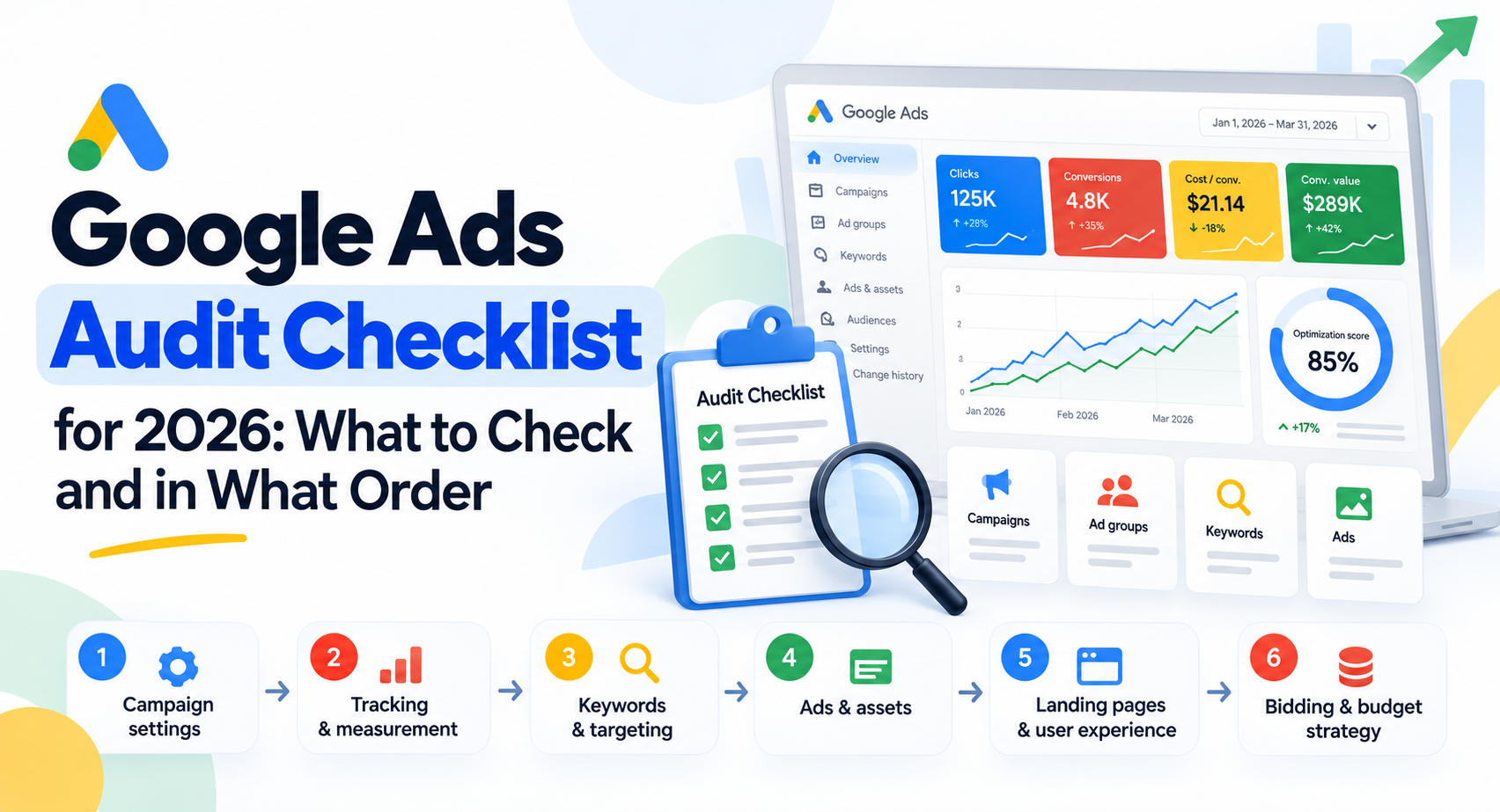
Do not audit an account in the same order the interface presents its settings. Follow the causal dependencies instead.
- Define the business outcome.
- Validate conversion truth.
- Confirm the account can deliver to the intended market.
- Audit the demand being purchased.
- Review structure only after upstream issues are understood.
- Audit bidding and budget using trusted measurement.
- Review the ad-to-landing-page conversion path.
- Audit AI Max and other automation controls.
- Run campaign-specific PMax or ecommerce modules where relevant.
- Use Change history to test root-cause hypotheses.
- Prioritize findings by impact, confidence and dependency.
This order prevents a common audit mistake: trying to improve a bidding strategy that is optimizing toward bad conversion data.
Define the Business Outcome Before You Judge CPA, ROAS or Campaign Structure
The audit needs a written definition of success before platform metrics can be judged. Determine whether the business is trying to generate qualified leads, closed sales, profitable revenue, bookings, subscriptions, store visits or another measurable outcome.
Then connect Google Ads metrics to that outcome. CPA, CPL and ROAS have meaning only when the conversions and values behind them reflect something commercially useful.
| Google Ads Metric | Business Validation | Audit Question |
|---|---|---|
| Conversions | Qualified outcomes or completed sales | Are the counted actions valuable enough to guide bidding? |
| CPL or CPA | Qualified lead cost or customer acquisition cost | Does the platform efficiency survive after lead quality is considered? |
| ROAS | Margin and contribution | Does the reported revenue create acceptable economics? |
| Conversion value | Real differences in customer or order value | Do submitted values help Google distinguish better outcomes? |
| Revenue | Profitability, fulfilment and returns | Is revenue translating into useful business contribution? |
Low CPA Can Still Be Bad Business
A low cost per lead is useful only when those leads have enough commercial value. Raw lead volume can hide weak qualification and poor close rates.
Consider a hypothetical campaign generating 100 leads at ₹500 per lead. The account reports a ₹500 CPL, but only 25 leads are qualified. The effective cost per qualified lead is ₹2,000 before considering sales conversion.
If another campaign generates fewer leads at ₹800 each but produces a much higher qualified lead rate and more customers, the second campaign may be commercially stronger even though its platform CPL looks worse.
The audit finding should therefore describe the downstream effect. "CPL is high" is not enough. "CPL is ₹800, but cost per qualified lead is lower because qualification is materially stronger" produces a different decision.
High ROAS Is Not the Same as Profit
ROAS measures conversion value relative to advertising cost. It does not automatically include product margin, returns, fulfilment costs, shipping subsidies, payment fees, inventory constraints or other commercial factors.
A high-revenue product can have weak contribution. A lower-ROAS product can sometimes produce stronger profit. The audit should not impose a generic ROAS threshold across businesses or even across every product inside the same ecommerce account.
The output of this stage should be a simple success definition: the primary KPI, the business validation metric and the economic threshold the rest of the audit will use.
Do Not Trust CPA or ROAS Until You Audit Conversion Truth
Conversion tracking passes an audit only when the action is technically captured, represents the right business event, is counted and valued correctly, and can be reasonably reconciled with the business system. A green tag status is not enough.
Review the conversion action list before judging campaign performance. Identify what is Primary, what is Secondary, which goals are active for each campaign, how conversions are counted, whether transaction identifiers are used where needed, and whether revenue or lead values match the real outcome.
Primary and Secondary Conversions Are Not Interchangeable
In Google Ads, Primary conversion actions are normally included in the Conversions column and can be used for bidding when the associated goal is active. Secondary conversion actions are normally observation-only and appear in All conversions, although custom-goal behavior creates an important exception.
| Dimension | Primary | Secondary | Audit Question |
|---|---|---|---|
| Main role | Optimization and core reporting | Observation and supporting reporting | Should this event influence bidding? |
| Typical column | Conversions | All conversions | Where is the event being evaluated? |
| Business meaning | Usually a meaningful outcome | Usually a supporting action | Does the role match the business objective? |
| Audit risk | Shallow actions may steer bidding | Important outcomes may be excluded from optimization | Is the campaign learning from the correct outcome? |
For a lead-generation account, a form submission or qualified phone call may deserve Primary status. A page view, chat open or brochure download may still be useful to observe without necessarily guiding Smart Bidding.
Do not convert this into a rule that every micro-conversion must always be Secondary. The correct role depends on the campaign goal. The audit question is whether the bidding signal matches the intended business outcome.
A Tag Can Fire Correctly and Still Be Commercially Wrong
Technical firing proves only that an event was recorded. It does not prove that the event is the right optimization goal.
Audit for duplicate purchases, repeated lead events, incorrect counting settings, missing transaction IDs, wrong currencies and incorrect conversion values. Then reconcile totals against GA4, the ecommerce backend or CRM where those systems provide a useful independent reference.
A hypothetical lead account might show four Primary actions: form submission, qualified call, page view and chat open. Every tag could fire perfectly, yet Smart Bidding may be rewarded for generating page views and chat opens that do not create qualified opportunities.
That is a measurement integrity problem, not a bidding problem.
Audit Enhanced and Offline Conversion Pipelines Using 2026 Configuration
Google changed enhanced-conversion configuration in 2026. Enhanced conversions for web and leads moved toward a unified setting, and from June 15, 2026 Google moved offline conversion import and enhanced-conversions-for-leads uploads toward the Data Manager API for current and future uploads.
For lead-generation accounts, audit the whole pipeline rather than checking only whether an offline import exists:
- Is first-party customer data captured correctly?
- Are offline stages imported?
- Do diagnostics show failures or missing data?
- Are qualified stages reaching Google Ads?
- Do imported values represent real differences in lead or customer quality?
- Can CRM outcomes be reconciled with Google Ads reporting?
Do not turn the audit into a complete implementation tutorial. The decision needed here is whether the conversion pipeline is trustworthy enough for later bidding, search-demand and budget conclusions.
Review Attribution After Conversion Definitions Are Trusted
Attribution should be reviewed after the conversion actions, values, counting and deduplication have been validated. Changing attribution cannot turn an irrelevant or duplicated conversion into a meaningful business outcome.
Data-driven attribution is the default model for many eligible Google Ads conversion actions. Its job is to distribute credit across interactions. It does not change the commercial meaning of the conversion being credited.
The output of the conversion audit should be a conversion-truth map showing which actions steer bidding, which actions are observational and which measurement gaps make later conclusions unreliable.
Confirm the Account Can Deliver to the Right Market Before Diagnosing Performance
Before blaming keywords, bids or ads, confirm that the account is eligible to serve and configured to reach the intended market. Review access, billing, policy status, campaign dates, locations, advanced location options, languages, networks and the intended role of each campaign.
| Area | What to Verify | Why It Matters |
|---|---|---|
| Access and ownership | Correct users, managers and ownership | Unknown access creates governance and change risk |
| Billing | Payment status and interruptions | Delivery problems can look like campaign performance problems |
| Policy and eligibility | Disapprovals or restrictions | Suppressed delivery changes every downstream metric |
| Dates | Start and end dates | Old settings can quietly stop or limit campaigns |
| Locations | Targets and advanced location behavior | Wrong reach creates poor traffic before keywords are judged |
| Languages and networks | Fit with intended audience and campaign role | Unexpected inventory can alter traffic quality |
Audit Location Options, Not Just the Location List
Google Ads geographic targeting can use physical location and location-interest signals depending on the selected location option. Google's location systems use multiple signals and are not perfectly precise.
This matters for local lead generation. A Surat business can target Surat and still see traffic associated with users outside the physical area if the selected location option allows people who show interest in that location.
That does not automatically mean targeting is broken. Compare the advanced location setting with the business objective and inspect the actual geography and lead quality before creating a finding.
This stage should end with one of three conclusions: delivery is aligned, delivery is misconfigured, or more evidence is needed.
Audit the Search Demand You Actually Bought, Not Just the Keywords You Chose
A Search audit should evaluate the real demand Google matched to the account. Use the Search terms report and Search terms insights together, then judge that demand by commercial intent, conversion quality, brand treatment and landing-page fit.
Do not start with match-type ideology. Broad match, phrase match and exact match are mechanisms. The audit needs evidence of what they produced.
Use Search Terms Report and Search Terms Insights Together
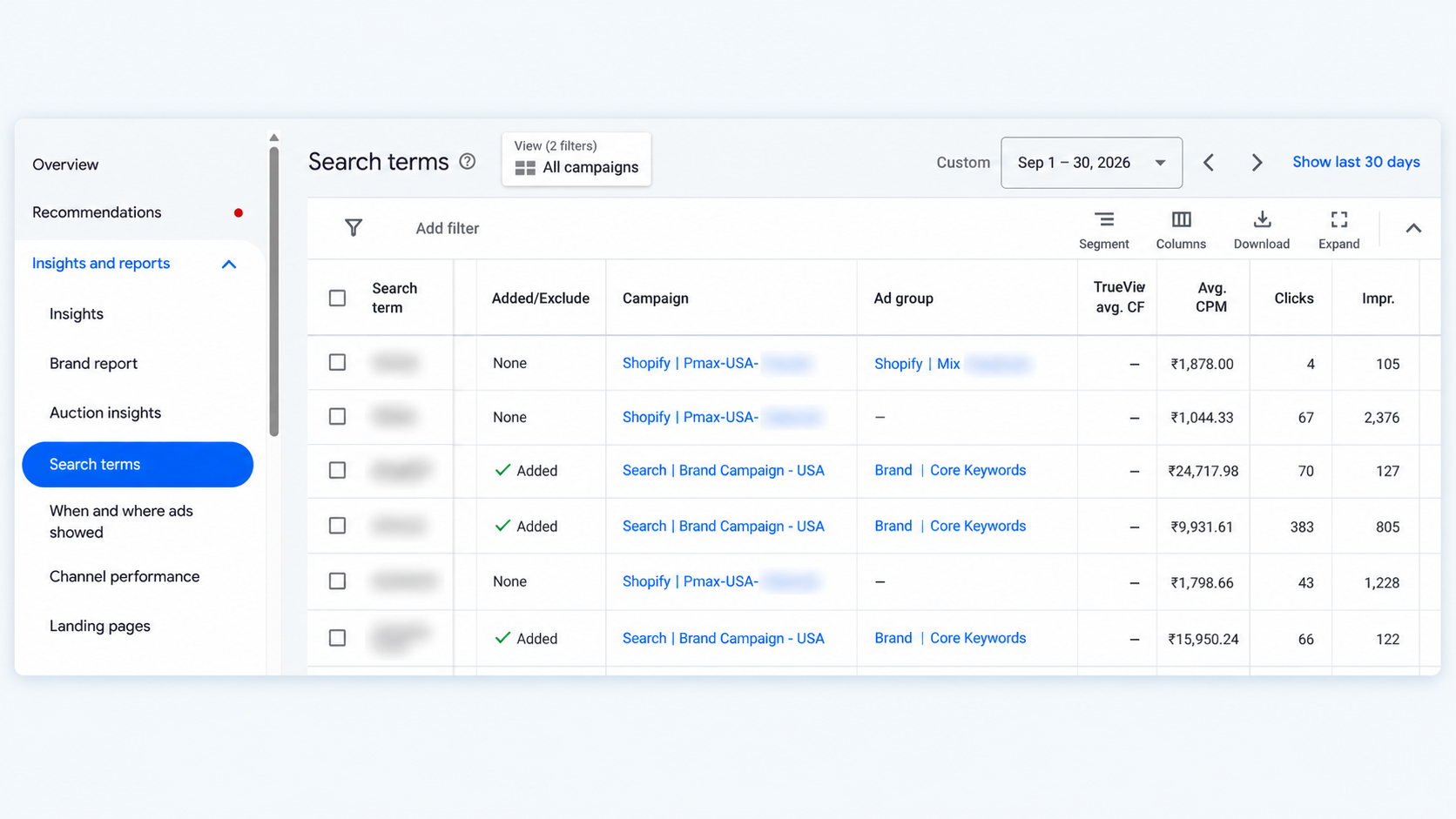
The Search terms report provides query-level evidence for searches that meet Google's reporting thresholds. Search terms insights group demand into themes and subthemes and can account for low-volume activity that is not individually exposed in the report because of privacy thresholds.
| Dimension | Search Terms Report | Search Terms Insights |
|---|---|---|
| View | Individual reportable queries | Aggregated themes and subthemes |
| Privacy | Some low-volume terms are omitted | Low-volume activity can be grouped into broader categories |
| Best use | Specific query investigation | Broader demand and intent diagnosis |
| Audit question | Which visible searches triggered traffic? | Which demand themes are the campaigns reaching? |
A visible query table can look clean while insights show a meaningful share of research, support, employment or other low-commercial-intent themes. The reverse can also happen: a few strange visible queries may look alarming even though they represent little material spend.
Organize findings by demand theme rather than producing a spreadsheet of isolated "bad keywords."
Judge Broad Match by Outcomes and Controls, Not Match-Type Ideology
Broad match is not automatically evidence of waste. In modern Search, it interacts with Smart Bidding and other contextual signals. The audit should inspect the resulting search demand, negatives, conversion quality and landing alignment.
Broad match becomes an actionable finding when evidence shows that it is repeatedly bringing commercially irrelevant demand, routing traffic poorly or operating with weak measurement and insufficient controls.
It should not be removed only because an older checklist says exact match is safer.
Audit Negative Keywords in Both Directions
Negative keywords can prevent irrelevant traffic, but they can also block useful demand. Review existing negatives for both missing exclusions and excessive exclusions.
Look for recurring irrelevant themes with material cost, but also check whether broad account-level or shared-list negatives conflict with current products, locations or services.
The audit question is not "How many negatives does this account have?" It is "Do the negatives protect commercial intent without excluding valuable demand?"
Duplicate Keywords Create Routing Problems, Not a Self-Bidding Penalty
Similar or overlapping keywords can create unclear intent ownership, inconsistent routing and reporting noise. They do not turn one advertiser into two independent bidders competing against each other in the same auction.
Treat overlap as a control problem when it prevents you from understanding which campaign or ad group should own a particular type of demand, especially when different landing pages, budgets or business economics are involved.
The output of this stage should be a demand-quality map organized by commercial intent, not a match-type score.
Restructure Only When the Existing Structure Blocks Control or Clean Evaluation
A messy Google Ads account does not automatically need rebuilding. Restructure only when the current architecture prevents meaningful control, goal alignment, budget ownership or clean interpretation.
By this point in the audit, conversion truth and demand quality should already be understood. That prevents structure from being blamed for an upstream tracking or traffic problem.
| Situation | Repair | Restructure or Rebuild | Reason |
|---|---|---|---|
| Messy naming | Usually | Rarely | Governance problem unless control is affected |
| Different business goals mixed together | Sometimes | Often worth separating | Goals may require different bidding and measurement |
| Different geographies with different economics | Depends | Useful when separate control is required | Budget and performance need independent interpretation |
| Products with materially different economics | Depends | Consider when control is blocked | Commercial priorities may require separation |
| Historical tracking issue | Fix measurement first | Not automatically | A rebuild does not repair bad conversion truth |
Messy Naming Is Not the Same as Broken Architecture
Naming conventions help teams understand and govern accounts. They do not directly prove performance quality.
Architecture becomes a finding when different goals, regions, brands, product groups or intent types need different decisions but the current structure prevents those decisions. For example, if two countries have different lead values and sales capacity but are forced into one budget and one optimization objective, the structure may genuinely block control.
Preserve useful history when targeted repair is enough. Rebuilding an account simply because it does not match the auditor's preferred template creates disruption without proving business value.
Audit Bidding and Budget Only After Measurement and Economics Are Trusted
Bidding should be evaluated against trusted conversion data and the business objective established earlier. Review whether the strategy fits the outcome, whether Target CPA or Target ROAS still represents acceptable economics, and whether budget or another constraint is actually limiting the campaign.
Do not replace a bidding strategy just because another strategy appears in a generic checklist. The full taxonomy belongs in the separate guide to Google Ads bidding strategies.
| Control | What It Sets | Audit Question | Typical Misdiagnosis |
|---|---|---|---|
| Budget | Spend capacity | Is useful demand being restricted by available spend? | Increasing budget when another constraint prevents spending |
| Target CPA | Cost-efficiency objective | Does the configured CPA target match current economics? | Calling the campaign budget-limited when the target is restrictive |
| Target ROAS | Value-efficiency objective | Does the return target match the business's value economics? | Treating higher ROAS as automatically better |
Budget and Target CPA or Target ROAS Are Different Controls
A campaign can have budget available and still be constrained by a restrictive efficiency target. More budget does not automatically create additional useful participation when Target CPA or Target ROAS is the active constraint.
Likewise, Limited by budget does not prove that increasing spend is the correct business decision. Audit the economic quality of the incremental opportunity before changing capacity.
Recheck Target CPA and Target ROAS After the August 2026 Change
Google changed target-based bidding behavior on August 17, 2026 for affected campaigns that are Limited by budget. The global rollout completed on August 27, 2026. Google says those campaigns are now intended to perform more consistently toward the configured target, including when budget changes. Google did not automatically change advertiser budgets or targets.
This makes stale targets especially important to audit. If a campaign historically operated far above or below the stated target and the business never revisited that setting, the configured target may now matter more directly to delivery.
Do not assume every account will respond identically. The finding should state whether the current target conflicts with present business economics.
If the audit proves that budget is genuinely the active constraint and the account is economically ready to scale, the next step is the separate framework on when to increase Google Ads budget.
Audit Ads, Assets and Landing Pages as One Conversion Path
Creative and landing pages should be audited as one path: user intent, ad message, selected landing page, conversion experience and eventual qualified outcome.
If traffic is commercially relevant but results remain weak, repeatedly changing targeting may attack the wrong part of the system.
| Stage | What to Check | Evidence |
|---|---|---|
| Intent | Commercial relevance | Search terms, audience context and outcome quality |
| Ad message | Promise and differentiation | Actual ads, assets and query relationship |
| Landing page | Intent match and offer clarity | Final landing URL and page content |
| Conversion path | Form, checkout or booking friction | Conversion rate and user journey |
| Business outcome | Lead or sale quality | CRM, sales and ecommerce data |
If Queries Are Relevant but Outcomes Are Weak, Look Beyond Targeting
When query intent is strong but conversion performance is weak, inspect message and post-click experience before narrowing traffic unnecessarily.
Review whether the ad promise matches the page, whether the user can understand the offer quickly, whether the mobile experience creates friction, and whether the form or checkout asks for unnecessary effort.
For lead generation, continue past the form. A landing page can produce many submissions while qualification or sales follow-up fails later.
The output should name the weakest proven stage in the path rather than saying "ads need improvement."
Use Quality Score as a Clue, Not the Audit Verdict
Quality Score can help investigate patterns involving expected CTR, ad relevance and landing-page experience. It is not a profitability score and should not become the overall account-health metric.
A low Quality Score can justify investigation. It does not prove that the campaign should be paused, restructured or rebuilt without supporting evidence from traffic quality and business performance.
A 2026 Search Audit Is Incomplete Without AI Max Controls
AI Max is an optimization layer inside Search campaigns, not a separate campaign type. A current Search audit should check whether AI Max is active and inspect the individual controls that can affect matching, creative and landing-page selection.
Audit What AI Max Can Change, Not Just Whether It Is On
AI Max includes search term matching and asset optimization. Current controls can include search term matching, text customization, Final URL Expansion, locations of interest, brand settings, URL controls and related reporting.
Audit each control through evidence:
- What additional search demand did search term matching reach?
- What text or assets were customized?
- Which landing pages were actually used?
- Did location-interest behavior align with the intended market?
- Were brand inclusions or exclusions consistent with strategy?
- Were URL inclusions or exclusions controlling the correct pages?
- Can reporting explain why the observed traffic or routing occurred?
AI Max being enabled is not itself a finding. A finding requires a connection between a control and an observed business or traffic effect.
Audit the Landing Page Google Actually Served
When Final URL Expansion is active, the entered final URL is not necessarily the complete routing story. AI Max can select another relevant page from the advertiser's domain and use text customization to align the ad with that destination.
Suppose a service campaign is configured around a high-intent service page, but reporting shows traffic reaching a weaker blog or category page. The audit should inspect the actual routing, query intent and outcomes before deciding whether URL exclusions are needed.
Do not disable Final URL Expansion simply because another URL was used. Constrain it when the evidence shows that routing is commercially weak or conflicts with the campaign objective.
The section output should be a control-by-control verdict: aligned, constrain, test or insufficient evidence.
Audit the Automations That Can Change the Account Without a Manual Edit
Recommendations should be treated as hypotheses, not audit verdicts. Review Recommendations, Optimization Score and auto-apply settings, then inspect scripts, automated rules, API integrations and Change history for other sources that can alter the account.
Optimization Score Is Not the Account-Health Score
Google describes Optimization Score as an estimate of how well the account or campaign is set to perform. Recommendations use account history, settings and Google trends, but Google also states that the Recommendations page does not predict whether the ads will perform well.
An account at 100% Optimization Score can still have poor conversion definitions, weak lead quality, bad product economics or irrelevant traffic. An account below 100% may have intentionally dismissed recommendations that conflict with its business model.
Audit the recommendation, not the percentage.
Check Auto-Apply, Rules, Scripts and APIs for Hidden Change Sources
Google Ads can apply selected recommendations automatically when the account is opted in. Google provides a queue and history for these actions, and auto-applied recommendations can also be reviewed through Change history.
Then check the non-Google automation layer. Identify active scripts, scheduled rules, API integrations and external tools. Document what each system is allowed to change, who owns it and how its changes are validated.
An automation becomes an audit finding when it can materially alter account behavior without a clear business rule, accountable owner or review process.
Run a Separate Performance Max Audit Module Instead of Calling It a Black Box
Performance Max should be audited from inputs to outputs: goals and values, search demand, search themes, negatives, brand controls, URL routing, assets, audience signals, product eligibility where relevant, bidding, budget and final business outcome.
This module is conditional. Skip it when the account has no Performance Max campaigns.
PMax Now Has Direct Search-Term Evidence and Negative Controls
Older advice that describes Performance Max as having no search-term visibility is outdated. Google now provides a Performance Max search terms report, alongside search terms insights, although privacy and aggregation limitations still apply.
Performance Max also supports negative keyword controls for Search and Shopping inventory. Current Google documentation includes campaign-level and account-level options.
The audit should therefore inspect real search evidence rather than declaring PMax a black box and stopping there.
Use Brand Exclusions and Negative Keywords for Different Jobs
Negative keywords block matching queries. Brand exclusions are designed to handle brand-family exclusions more broadly and can account for common variants and related brand entities. Google currently recommends brand exclusions when the objective is comprehensive brand exclusion.
| Control | Primary Use | Audit Question |
|---|---|---|
| Negative keywords | Block specific irrelevant or unsuitable query patterns | Is the exclusion necessary and commercially justified? |
| Brand exclusions | Control brand-family search participation | Does the campaign need to exclude this brand demand? |
Do not exclude branded demand by default. The correct control depends on the account's role, brand strategy and economics.
Audit PMax Routing and Assets Without Using Asset Strength as the Verdict
Final URL Expansion is on by default for standard Performance Max campaigns and can send users to another relevant page on the advertiser's domain. URL exclusions can be used where certain destinations should not receive paid traffic.
Review the landing pages that actually received traffic, not only the URL entered during setup.
Also inspect asset-group reporting and combinations in context. A single surface-level score is not enough to prove that an asset group is commercially strong or weak. Audience signals should also be treated as signals that guide the system, not as rigid targeting walls.
When the audit identifies deeper PMax management issues beyond checklist depth, hand that work to the dedicated Performance Max management framework rather than expanding this article into a full PMax guide.
For Ecommerce, Add a Merchant Center and Product-Data Audit Module
Retail accounts need a second system audited alongside Google Ads: Merchant Center. Review product eligibility, offer accuracy, identifiers, titles, images, destination URLs, custom labels and whether conversion values support useful commercial decisions.
This module applies to Shopping and retail Performance Max accounts. Skip it for non-retail advertisers.
| Layer | What to Check | Why It Matters |
|---|---|---|
| Needs attention | Account and product issues | Eligibility problems can block participation |
| Product eligibility | Approval and destination status | A product cannot perform where it is not eligible |
| Offer data | Price and availability | Mismatch undermines trust and eligibility |
| Identifiers and media | GTIN, brand, images and product identity | Weak product data reduces product clarity |
| Destination URLs | Correct product and variant page | Wrong routing weakens the purchase path |
| Values and custom labels | Commercial usefulness | Segmentation and bidding need meaningful business data |
Use Needs Attention, Not the Legacy Diagnostics Label
Merchant Center now uses Needs attention for the product-issue surface previously known as Diagnostics. Google describes this area as the place to identify product and account issues that need action.
Check eligibility before explaining poor Shopping or retail PMax performance. A disapproved or limited product has a fundamentally different problem from an approved product that is receiving poor traffic.
Approved Products Can Still Have Weak Product Data or Economics
Approval is necessary, but it is not proof that the retail data layer is strong. An approved product can still have weak titles, inaccurate variant handling, poor images, incorrect landing destinations or values that do not help the advertiser distinguish profitable products from weak ones.
Separate four types of findings:
- Eligibility: Can the product participate?
- Accuracy: Does the product data match the actual offer?
- Relevance: Does the data clearly represent what the product is?
- Commercial control: Can the advertiser use the data to make useful allocation decisions?
Do not expand this stage into a full Merchant Center feed-optimization tutorial. The audit needs only enough depth to identify which retail-data layer is creating the constraint.
Use Change History to Explain Performance Shifts Before You Make Another Change
When performance moves suddenly, inspect Change history around the inflection point before changing the account again. Google Ads retains Change history for the previous two years and can show many manual, API and system-related changes.
Compare the performance timeline with changes to conversion goals, budgets, bidding, targeting, ads, keywords and automated recommendations.
Check Change History Early for Sudden Drops and Again at the End for Governance
Use Change history early when a sudden performance drop triggered the audit. It can narrow the list of possible causes quickly.
Suppose ROAS falls shortly after three events: a new Primary conversion is introduced, budget is increased and an automated recommendation changes targeting. Those changes are useful hypotheses, but timing alone does not prove which one caused the decline.
Validate each hypothesis against the account evidence. Did conversion mix change? Did search demand change? Did incremental spend move into weaker traffic? Did landing-page routing change?
Review Change history again near the end of the audit for governance. Repeated unexplained API or automated changes can be a finding even if no single change caused the current performance problem.
The output should be a root-cause timeline: change, observed shift, supporting evidence, conflicting evidence and confidence level.
Turn Audit Observations Into Prioritized Findings, Not a Score
The audit should end with an implementation order, not a percentage score. Fix issues that corrupt measurement, eligibility or the business objective first. Address material traffic or economic problems next. Test uncertain hypotheses. Monitor incomplete evidence. Ignore cosmetic differences that do not change a business decision.
Fix Integrity Problems Before Performance Tweaks
Dependency determines priority. A duplicate purchase conversion can invalidate ROAS, Smart Bidding and budget conclusions downstream. That deserves attention before a weak RSA headline or a minor naming problem.
A practical priority order is:
- Wrong business objective or conversion corruption
- Eligibility or delivery blockers
- Material irrelevant traffic with strong evidence
- Economic or bidding misalignment
- Landing-path or automation-control issues
- Testable creative or structural hypotheses
- Cosmetic or low-impact observations
Do not rank something higher merely because it is easy to change or because the auditor has a strong personal preference about the setting.
Use Fix, Test, Monitor or Ignore as the Action Type
| Action | Use When | Example |
|---|---|---|
| Fix | Evidence is strong, impact is material and the issue blocks trustworthy downstream decisions | Duplicate purchase tracking inflates conversion value |
| Test | The issue is plausible and material, but causal evidence is incomplete | A different landing page may improve qualified outcomes |
| Monitor | Impact is currently low or the data is not mature enough | Recent performance change inside the normal conversion-delay window |
| Ignore | The observation is intentional or cosmetic and changes no meaningful decision | Campaign naming differs from the auditor's preferred format |
Document Every Important Finding the Same Way
| Field | What to Record |
|---|---|
| Finding | The diagnosed issue, not just the observed setting |
| Evidence | Reports, configuration, backend data or history supporting the finding |
| Business impact | Why the issue matters commercially or diagnostically |
| Confidence | How strong the causal evidence is |
| Dependency | Which later decisions rely on fixing or understanding this issue |
| Action | Fix, Test, Monitor or Ignore |
| Owner | Who is responsible for implementation or validation |
| Validation metric | What evidence will confirm that the action worked |
Rebuild Only When Architecture Is the Constraint
A full account rebuild should not be the default output of an audit. Rebuild when the architecture prevents correct measurement, independent budget control, goal separation or clean interpretation and targeted repair cannot reasonably solve the problem.
If conversion tracking is wrong, fix conversion tracking. If search demand is irrelevant, fix the demand problem. If the account simply looks untidy, do not destroy useful history for cosmetic reasons.
If you complete the DIY audit but still cannot identify the earliest material constraint, a professional Google Ads account audit should focus on evidence, reconciliation and prioritization rather than producing a longer list of settings.
Use Health Checks for Drift and Deep Audits for Strategic Questions
There is no universal monthly or quarterly deep-audit frequency. Use lightweight recurring health checks to catch breakage and drift, then run a deeper strategic audit when risk, spend, data volume, account change or a business event justifies revalidating the system.
| Review Type | Depth | Typical Trigger | Primary Output |
|---|---|---|---|
| Alert check | Very light | Billing, policy, tracking or sudden delivery issue | Immediate integrity verdict |
| Recurring health review | Light | Normal account governance | Drift or anomaly detection |
| Strategic audit | Deep | Major performance or business question | Prioritized causal findings |
| Event-triggered audit | Deep where relevant | Account handoff, migration, budget shift or campaign-model change | Revalidation of affected dependencies |
Audit After Events, Not Just Because the Calendar Says So
A deeper audit is especially useful after an account takeover, unexplained performance shift, major budget increase, CRM or tracking migration, adoption of new automation, major campaign-model change or before a large restructure.
The appropriate cadence also depends on conversion delay. An account with long sales cycles may need more mature data before some conclusions can be classified as findings.
The operating model is simple: use health checks to detect drift, and deep audits to answer strategic questions.
Google Ads Audit Checklist FAQs
What should I check first in a Google Ads audit?
Start with the business objective and conversion integrity. Define what the account is supposed to produce, then verify that the Primary conversion actions guiding bidding represent that outcome accurately. Keywords, budgets, bidding and campaign structure are downstream decisions. If conversion truth is wrong, later CPA, ROAS and automation conclusions may also be wrong.
Should I change settings while auditing Google Ads?
Usually, gather evidence before implementing changes. Changing several settings during diagnosis can make the original cause harder to isolate. An exception is an urgent integrity or eligibility problem, such as broken conversion measurement, billing failure or a critical policy issue. For normal performance findings, document the evidence and priority first, then implement fixes or tests deliberately.
How do I know if conversion tracking is inflating results?
Check which actions are Primary, the counting method, duplicate events, transaction IDs, values, currency and whether Google Ads totals reconcile reasonably with the ecommerce backend, CRM or another trusted source. A tag firing correctly does not prove the conversion is unique or commercially meaningful. Repeated purchases or lead events without proper deduplication can inflate conversion counts and values.
Should I trust Google Ads recommendations during an audit?
Treat recommendations as hypotheses. Google uses account history, settings and broader trends to produce them, but the Recommendations page does not know every business constraint. Review whether each recommendation supports the actual goal, economics and account evidence. Also audit auto-apply settings so you know which recommendation types can change the account without a manual edit.
What should I check in Google Ads Change history?
Review the period around meaningful performance shifts and look for changes to conversion goals, budgets, bid strategies, targets, keywords, targeting, ads and automated settings. Identify whether the source was a user, API or Google system where that information is available. Timing creates a root-cause hypothesis, but validate it with performance and business evidence before claiming causation.
Should I rebuild a messy Google Ads account after an audit?
Only when the architecture blocks meaningful control, measurement or clean evaluation. Messy campaign names, old campaigns or a structure that differs from your preferred template are not enough. Preserve useful history where targeted repair can solve the problem. Rebuild when separate goals, economics, regions or control requirements cannot be managed reliably inside the current architecture.
How often should I audit Google Ads?
Use recurring health checks for breakage and drift, then run deeper audits when events or account risk justify them. Triggers can include account handoff, unexplained performance change, major budget movement, tracking migration, new automation or a planned restructure. There is no universal monthly or quarterly deep-audit schedule that fits every account.
The Best Google Ads Audit Finds the First Problem That Makes Later Decisions Unreliable
The value of a Google Ads audit is not the number of items checked. It is whether the audit proves the earliest material constraint and creates a safe order for what happens next.
Before changing the account, document the most important findings with evidence, business impact, confidence, dependency, action type, owner and validation metric. Fix upstream integrity problems first. Test uncertain performance ideas second. Monitor what does not yet have mature evidence, and leave intentional low-impact differences alone.
That turns the audit from a settings review into an evidence-backed action plan.