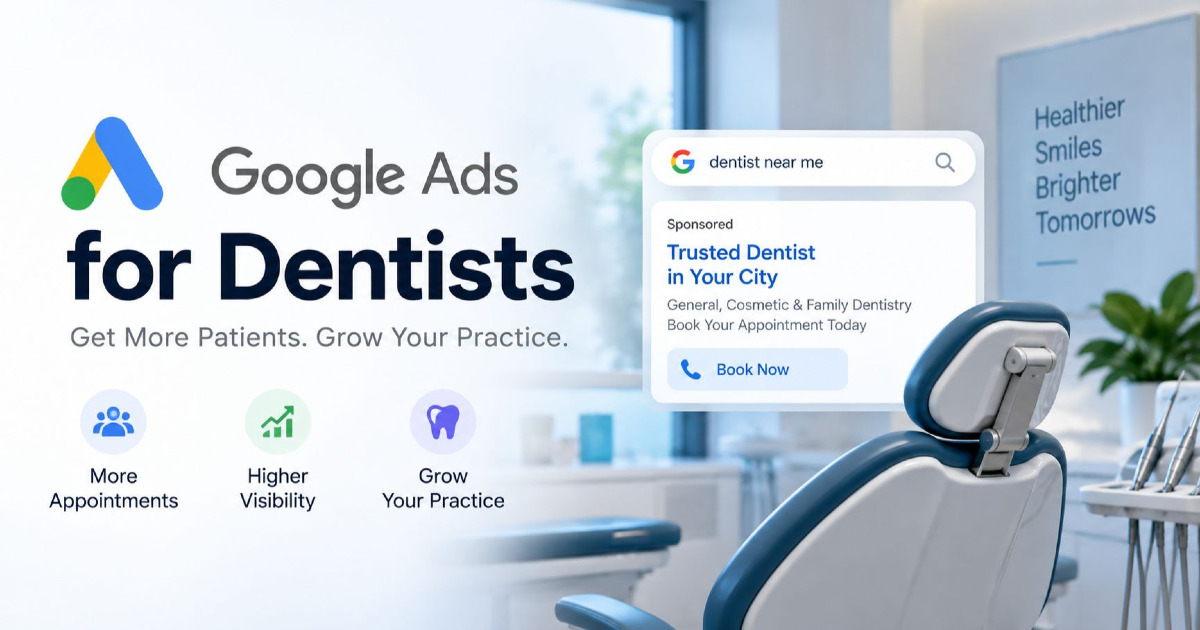
Google Ads can be one of the fastest ways for a dental clinic to reach people who are actively looking for a dentist, dental treatment, emergency appointment, implant consultation, Invisalign provider, root canal specialist or another dental service.
The biggest advantage is timing. Someone searching Google for “dentist near me”, “emergency dentist open now” or “dental implants near me” already has a need. You are not trying to create interest from nothing. You are trying to make your clinic the best next choice.
That does not mean Google Ads automatically produces patients. Dental clicks can be expensive, especially in competitive cities. A campaign can generate plenty of impressions, clicks and even form submissions while producing very few booked or completed appointments.
A strong dental Google Ads setup connects the complete path:
Search → Keyword → Ad → Landing Page → Call or Form → Appointment → Patient
If one part of that path is weak, money gets wasted. Wrong keywords bring the wrong people. Generic ads fail to stand out. Weak landing pages lose good traffic. Poor tracking teaches Google to optimise for the wrong actions. Slow follow-up loses patients after the advertising has already done its job.
This guide explains how I would structure Google Ads for dentists in 2026, including campaign types, keywords, negative keywords, budgets, location targeting, ads, landing pages, conversion tracking, bidding and ongoing optimisation.
Google Ads for Dentists: Table of Contents
- Does Google Ads Work for Dentists?
- Which Dental Services Should You Advertise?
- Best Google Ads Campaign Types for Dentists
- How to Structure Dental Google Ads Campaigns
- Best Google Ads Keywords for Dentists
- Negative Keywords for Dental Campaigns
- Location Targeting for Dental Clinics
- How Much Should Dentists Spend on Google Ads?
- How to Write Better Dental Google Ads
- Landing Pages for Dental Google Ads
- Conversion Tracking for Dentists
- Google Ads Bidding for Dental Campaigns
- What Happens After the Lead Arrives?
- Google Ads Policies Dentists Should Know
- How to Optimise Dental Google Ads
- Common Dental Google Ads Mistakes
- Google Ads vs SEO for Dentists
- Frequently Asked Questions
Does Google Ads Work for Dentists?
Yes, Google Ads can work very well for dentists because dental services often have strong local search demand. People commonly use Google when they need a nearby provider, have pain, want treatment pricing, need an urgent appointment or are comparing dentists before making a decision.
The key is understanding that not every dental search has the same value. Someone searching “what causes tooth sensitivity” may only be researching a problem. Someone searching “emergency dentist near me open now” is much closer to contacting a clinic.
Google Ads works best when the campaign focuses its budget on searches that have a reasonable chance of becoming a patient rather than simply chasing large search volume.
What Do Dental Google Ads Cost?
Dental advertising is competitive. WordStream's 2026 Search advertising benchmark reported an average cost per click of approximately $8.00 for Dentists & Dental Services, with an average conversion rate of 10.67% and an average cost per lead of approximately $72.97.
These are broad U.S. benchmark figures across many advertisers. They should not be treated as a promise or target for an individual clinic. A dental implant campaign in Manhattan can behave very differently from a general dentistry campaign in a smaller city.
| Metric | 2026 Dental Benchmark | What It Tells You |
|---|---|---|
| Average CPC | $8.00 | Approximate average cost for a Search ad click |
| Average Conversion Rate | 10.67% | Approximate percentage of clicks that generated a measured lead |
| Average Cost per Lead | $72.97 | Approximate advertising cost for a measured enquiry |
Source: WordStream 2026 Google Ads Benchmarks.
The number that matters most is not necessarily CPC or even cost per lead. A clinic should eventually know its cost per qualified lead, cost per booked appointment and cost per new patient.
A $120 lead that becomes a $4,000 treatment may be far more useful than a $35 lead that never books.
Why Search Intent Makes Google Ads Suitable for Dental Clinics
Search advertising gives dentists access to demand that already exists. People tell Google what they need through the words they type.
Compare these searches:
- why does my tooth hurt
- root canal treatment
- root canal cost near me
- root canal dentist near me
- emergency root canal dentist open today
All five searches relate to the same general problem, but the likelihood of booking an appointment is different.
A good campaign does not treat all five searches equally. It separates high-intent searches from research searches and decides how much each group deserves to spend.
If you want the wider framework behind this approach, my Google Search Ads guide explains how search intent, keywords, ads, landing pages and conversions should work together.
Which Dental Services Should You Advertise on Google?
A common mistake is starting with every treatment listed on the clinic website. That usually spreads the budget too thin and makes it harder to understand which services are actually producing patients.
Choose the first treatments based on four questions:
- Are people actively searching for this treatment in your area?
- Does the clinic want more patients for this service?
- Can the clinic handle additional appointments?
- Can the value of the treatment support the expected advertising cost?
The correct answer varies by practice. A clinic focused on implants should not copy the campaign structure of a family dentist whose main goal is increasing regular new-patient registrations.
| Dental Service | Typical Search Intent | Possible Priority | Important Consideration |
|---|---|---|---|
| Emergency Dentistry | Very High | High | Clinic must be able to answer quickly |
| Dental Implants | High | High | Needs strong treatment page and trust |
| Invisalign / Clear Aligners | High | High | Patients often compare several providers |
| Root Canal | High | High | Pain and urgency can drive calls |
| General Dentist | High | High | Can attract a wide range of patient needs |
| Cosmetic Dentistry | Medium to High | Medium to High | Strong proof and visuals matter |
| Teeth Whitening | Medium | Test | Price competition can be strong |
| Dental Cleaning | Medium | Depends | Lower first-visit value may require tighter costs |
Emergency Dentistry
Emergency searches can be some of the strongest dental searches because the patient usually wants help now rather than weeks later.
Common searches include:
- emergency dentist near me
- dentist open now
- same day dentist
- urgent dental appointment
- broken tooth dentist
- severe tooth pain dentist
An emergency campaign only makes sense if the clinic can support the promise. If ads say “same-day appointments” but reception regularly tells callers to come next week, the problem is no longer advertising.
Emergency campaigns should normally make calling extremely easy, clearly show opening hours and avoid sending traffic through a long general enquiry process.
Dental Implants, Invisalign and Other Higher-Value Treatments
Treatments such as dental implants, full-mouth restoration, Invisalign and cosmetic dentistry can support a higher cost per lead because one successful patient can be worth considerably more than a routine visit.
However, these patients often spend more time comparing dentists. They may check qualifications, experience, reviews, treatment process, financing, location and previous patient results before contacting anyone.
That means these campaigns need more than a good keyword. They need a dedicated treatment page strong enough to answer the questions a serious patient will have.
General Dentistry and New-Patient Campaigns
General dentist campaigns can provide steady new-patient demand rather than focusing only on one treatment.
Useful searches can include:
- dentist near me
- family dentist near me
- dental clinic near me
- dentist accepting new patients
- dentist in [city]
- dentist open Saturday
The challenge is that broad general-dentist searches can also be highly competitive. The landing page should make the clinic's location, services, reviews, availability and new-patient process immediately clear.
Best Google Ads Campaign Types for Dentists
Dental clinics now have several ways to advertise across Google. That does not mean you should launch every campaign type on day one.
For most clinics, I would build around high-intent Search demand first, make sure conversion tracking works, and then expand only when there is a clear reason.
Google Search Ads Should Usually Be the Starting Point
Search campaigns allow you to target people who are actively searching for dental services. They also give you useful control over keywords, search terms, treatment groups, ads, locations and landing pages.
For example, you can separate:
- Emergency dentist searches
- Dental implant searches
- Invisalign searches
- Root canal searches
- General dentist searches
This makes it much easier to understand where the budget is going and which treatment is generating useful enquiries.
For the full build process, see my Google Ads Search campaign setup guide.
Local Services Ads Can Be Useful for Eligible U.S. Dentists
Google currently includes dentists among eligible healthcare categories for Local Services Ads in the United States. Local Services Ads are built around local lead generation and can appear when nearby people search for eligible services.
This can make them useful for clinics trying to attract local patients searching for a dentist rather than a very specific treatment.
Local Services Ads have their own eligibility, verification and location requirements. Availability should therefore be checked for the clinic rather than assumed.
Source: Google Local Services Ads.
Should Dentists Use Performance Max?
Performance Max can help Google find conversions across several Google properties, but I would not automatically make it the first campaign for a new dental account.
Search is easier to control while you are still learning:
- Which treatments generate good leads
- Which locations convert
- Which search terms waste money
- Which pages generate appointments
- Which leads actually become patients
Performance Max becomes more useful once the account has reliable conversion tracking and enough good-quality conversion data for Google to learn from.
If the account counts every form submission, accidental call and low-value action as equally important, adding more automation does not fix the measurement problem. It gives Google more room to chase the wrong signal.
Remarketing and YouTube Can Support Longer Dental Decisions
Not every dental patient books on the first visit. Implant, Invisalign and cosmetic patients may return several times before contacting the clinic.
Remarketing can help the clinic stay visible to previous visitors, subject to Google's healthcare and personalised advertising restrictions. Audience use for healthcare-related advertising requires extra care because health is treated as a sensitive category.
When suitable, remarketing creative should give a visitor another reason to consider the clinic rather than simply repeating “Book Now.” Useful messages may focus on dentist experience, patient reviews, treatment process, finance options or consultation information.
For general implementation concepts, see my Google Ads remarketing audience guide. For video campaign planning, my YouTube ad placements guide explains the difference between audience targeting, formats and placements.
How to Structure Google Ads Campaigns for a Dental Clinic
Campaign structure should make it easy to control budget and understand results. Do not put implants, emergency dentistry, Invisalign and general dentistry into one large campaign simply because they all belong to the same clinic.
Different treatments have different search terms, patient urgency, landing pages, lead values and acceptable costs.
A practical starting structure could look like this:
| Campaign | Ad Groups | Landing Page | Main Conversion |
|---|---|---|---|
| General Dentistry | Dentist Near Me, Family Dentist, New Patients | New Patient / General Dentistry Page | Call or Appointment |
| Emergency Dentist | Emergency Dentist, Dentist Open Now, Tooth Pain | Emergency Dentistry Page | Qualified Phone Call |
| Dental Implants | Implants, Implant Dentist, Full Mouth Implants | Dental Implant Page | Implant Consultation |
| Invisalign | Invisalign, Clear Aligners, Invisalign Cost | Invisalign Page | Consultation |
| Root Canal | Root Canal, Endodontist, Tooth Nerve Pain | Root Canal Page | Call or Appointment |
Keep Ad Groups Focused Around One Search Need
An ad group should contain keywords that can reasonably share the same ad message and landing page.
For example, these terms can fit together:
- emergency dentist near me
- urgent dentist near me
- emergency dental clinic
But putting “dental implants near me” into the same ad group would weaken the connection. The implant patient needs a different ad and a different page.
Separate Campaigns When Budget Control Matters
Budget is controlled at campaign level, which is one reason important treatments often deserve separate campaigns.
If dental implants are bringing useful consultations but the general dentist campaign is spending aggressively on weaker searches, separate campaigns allow you to change the budget without disrupting everything else.
This structure also improves reporting. Instead of seeing one blended cost per lead, you can see what an implant lead, emergency call or new-patient enquiry actually costs.
Best Google Ads Keywords for Dentists
The best dental keywords are not simply the phrases with the highest search volume. They are searches where the wording suggests that the user could realistically become a patient.
General Dentist Keywords
- "dentist near me"
- "dentist in [city]"
- "dental clinic near me"
- "family dentist near me"
- "local dentist"
- "dentist accepting new patients"
- "dentist open Saturday"
- "dentist appointment near me"
General dentist keywords can generate useful new-patient demand but may also match a wider range of needs. Search terms should be reviewed regularly to understand what people actually wanted when they clicked.
Dental Implant Keywords
- "dental implants near me"
- "implant dentist near me"
- "dental implant specialist"
- "dental implant consultation"
- "dental implant cost"
- "single tooth implant"
- "full mouth dental implants"
- "all on 4 dental implants"
Do not automatically block words such as cost, price or financing. For a high-value treatment, price research can be part of a serious patient's comparison process.
Emergency Dentist Keywords
- "emergency dentist near me"
- "dentist open now"
- "same day dentist"
- "urgent dentist"
- "emergency dental clinic"
- "broken tooth dentist"
- "tooth pain dentist"
- "weekend emergency dentist"
Emergency searches usually need different ads from routine dental campaigns. Opening hours, distance, phone availability and same-day capacity may matter more than a long explanation of every clinic service.
Invisalign and Orthodontic Keywords
- "Invisalign near me"
- "Invisalign dentist"
- "Invisalign consultation"
- "Invisalign cost"
- "clear aligners near me"
- "clear braces dentist"
- "orthodontist near me"
These users often compare more than one provider. The ad gets the click, but the landing page usually needs to do the heavier work of building trust.
Exact, Phrase and Broad Match for Dental Campaigns
Match type determines how much freedom Google has when connecting your keyword with a person's actual search.
| Match Type | Example | Useful When | Main Risk |
|---|---|---|---|
| Exact | [emergency dentist near me] | You want tighter starting control | May limit reach if used too narrowly |
| Phrase | "emergency dentist" | You want controlled expansion around the intent | Can still match unexpected searches |
| Broad | emergency dentist | You have strong tracking, bidding and search-term control | Can spend heavily on weak searches if signals are poor |
I generally prefer tighter control when a dental account is new and has limited conversion data. Phrase and exact match can help establish what actually works before allowing the campaign to expand more aggressively.
Broad match is not automatically bad. The problem is using broad match while also having weak conversion tracking, poor negative keywords and no routine search-term review.
Negative Keywords for Dental Google Ads
Negative keywords stop ads from appearing for searches you do not want to pay for. They are especially important for dentists because dental terms overlap with education, jobs, products, DIY treatment, research and professional supplies.
A useful negative keyword strategy starts with obvious irrelevant categories and continues by reviewing the actual Search Terms report after launch.
Job and Career Negative Keywords
- job
- jobs
- career
- careers
- salary
- salaries
- vacancy
- vacancies
- hiring
- recruitment
- internship
- internships
- dentist jobs
- dental assistant jobs
- dental hygienist jobs
- dental receptionist jobs
Education and Training Negative Keywords
- course
- courses
- training
- school
- college
- university
- degree
- certification
- exam
- study material
- textbook
- lecture
- dental school
- dental college
Research and Information Negative Keywords
- definition
- meaning
- Wikipedia
- presentation
- PowerPoint
- research paper
- journal
- diagram
- images
- pictures
Do not assume every informational word must be blocked. Some patients research treatments before booking. The point is to remove searches that clearly cannot become a patient, not to eliminate anyone who asks a question.
Dental Product and Supplier Negative Keywords
- equipment
- supplier
- suppliers
- wholesale
- dental chair
- dental instruments
- dental tools
- lab equipment
- dental supplies
- used equipment
- machine
- machines
DIY and Home Treatment Negative Keywords
- DIY
- home remedy
- home remedies
- home treatment
- kit
- kits
- how to do at home
- self treatment
Be careful with negative match types. Google negative keywords do not behave exactly like positive keywords, and close variants are not automatically covered in the same way. Review singular, plural and important wording variations where needed.
Also avoid blindly blocking terms such as cheap, affordable, cost, price or insurance. Whether those searches are valuable depends on the clinic, treatment and payment options.
Location Targeting for Dental Clinics
Dentistry is local, so poor location targeting can waste a large amount of budget without looking obviously broken.
The right target area depends on what is being advertised. A patient may travel only a few miles for routine cleaning but travel much farther for dental implants, specialist treatment or a provider they strongly trust.
Do Not Target an Entire State Just Because Google Allows It
A clinic with one physical location should start by understanding where existing patients actually come from.
Useful inputs include:
- Clinic address
- Patient ZIP codes or postcodes
- Real driving distance
- Nearby towns and neighbourhoods
- Public transport access
- Competing dental areas
- Treatment type
A tight area is not always better, but a large radius should have a reason behind it.
Use Different Geographic Reach for Different Treatments
Do not assume one location setting should apply to every campaign.
A general dentistry campaign could focus more heavily on areas close to the clinic. An implant specialist may be able to attract patients from a wider distance because patients are more willing to travel for a treatment they consider important.
After enough data is available, compare leads and booked patients by area. Some neighbourhoods may produce cheap clicks but weak leads. Others may cost more per click while repeatedly producing booked treatment.
Google Ads and Local SEO Should Support Each Other
Many dental patients will see an ad and then investigate the clinic separately. They may check Google Maps, reviews, photos, opening hours and the clinic's organic results before making contact.
This is why paid search should not be treated as isolated from local visibility. My Local SEO guide explains how Google Business Profile, local pages, reviews and location signals can support searches such as “dentist near me.”
How Much Should Dentists Spend on Google Ads?
There is no single monthly budget that is correct for every dental clinic.
A useful starting budget depends on:
- Average click cost in the market
- Number of treatments being advertised
- Local search volume
- Competition
- Clinic capacity
- Expected conversion rate
- Lead-to-appointment rate
- Patient value
A Simple Dental Google Ads Budget Example
Suppose a clinic has a monthly advertising budget of $3,000 and receives an average cost per click of approximately $8.
| Step | Example |
|---|---|
| Monthly Ad Spend | $3,000 |
| Average CPC | $8 |
| Estimated Clicks | 375 |
| Example Website Lead Rate | 10% |
| Estimated Leads | 37-38 |
| Example Qualified Lead Rate | 60% |
| Estimated Qualified Leads | 22-23 |
| Example Booking Rate | 50% |
| Estimated Booked Appointments | 11-12 |
This example is not a forecast. It simply shows why campaign planning should continue beyond CPC.
If those 11 appointments result in eight new patients, the clinic has learned much more than a report showing “375 clicks.”
Do Not Spread a Small Budget Across Too Many Treatments
If the budget is limited, choosing fewer priorities usually produces clearer information.
For example, a clinic with $2,000 per month may learn more by properly funding emergency dentistry and general new-patient searches than by dividing the same money across eight separate treatment campaigns.
Once one part of the account repeatedly produces useful patients, additional budget can be tested there or another service can be introduced.
Set Budget Based on Capacity Too
A campaign should not generate more demand than the clinic can reasonably handle.
If an implant dentist only has a few consultation slots available each month, there is little value in aggressively increasing spend just because the campaign can generate more leads.
Advertising works best when budget, appointment capacity and follow-up capacity are aligned.
How to Write Better Google Ads for Dentists
Many dental ads look almost identical because they rely on generic statements such as “Quality Dental Care,” “Experienced Dentist” and “Book Today.”
Those phrases are not necessarily wrong, but they give the patient very little reason to choose one clinic instead of another.
Better ads connect directly with the search and answer a useful question.
Example Emergency Dentist Ad
Possible headlines:
- Emergency Dentist Near You
- Same-Day Dental Appointments
- Call to Check Today's Availability
- Urgent Dental Care in [City]
- Help for Tooth Pain & Broken Teeth
Possible description:
Need urgent dental care? Contact our [City] dental clinic to check today's emergency appointment availability. Call now or request an appointment online.
The ad should not promise 24-hour care, immediate treatment or same-day appointments unless the clinic can genuinely provide them.
Example Dental Implant Ad
Possible headlines:
- Dental Implant Consultation
- Implant Dentist in [City]
- Explore Dental Implant Options
- Book an Implant Assessment
- Finance Options Available
Possible description:
Considering dental implants? Speak with our dental team about treatment options, expected process and available payment options. Request your consultation today.
Use Ad Assets to Give Patients More Information
Google Ads assets can make Search ads more useful and provide additional ways for potential patients to act.
Useful assets for dental clinics can include:
| Asset | Dental Example |
|---|---|
| Call Asset | Clinic phone number |
| Location Asset | Clinic address and map information |
| Sitelinks | Dental Implants, Emergency Dentist, Invisalign, New Patients |
| Callouts | Saturday Appointments, Finance Options, Family Dentistry |
| Structured Snippets | Services: Implants, Invisalign, Root Canal, Whitening |
| Image Assets | Real clinic or suitable approved dental images |
Call-Only Ads Have Changed in 2026
Phone calls are still extremely important for dental advertisers, but Google's setup has changed.
Google removed the ability to create new call-only ads in February 2026. The recommended replacement is a Responsive Search Ad with a call asset. Existing call-only ads are scheduled to stop receiving impressions in February 2027.
If an older dental account still depends heavily on call-only ads, it should be moved toward Responsive Search Ads with call assets rather than building new campaigns around the old format.
Source: Google Ads Help: Transition from call ads to call assets.
Landing Pages for Dental Google Ads
The landing page is often where a good dental campaign becomes a bad one.
A patient searches for a specific service, clicks an ad that appears relevant and then reaches a homepage containing every treatment the clinic provides. The patient now has to search the website again for the information they expected to see immediately.
Match the Landing Page to the Search
The path should be straightforward:
- Dental implant search → Dental implant page
- Emergency dentist search → Emergency dentistry page
- Invisalign search → Invisalign page
- Root canal search → Root canal page
- General dentist search → New-patient or general dentistry page
This improves message continuity. The keyword, ad and page all answer the same need.
What Should a Dental Landing Page Include?
A useful treatment landing page should normally answer the questions a patient needs before contacting the clinic.
- Clear treatment-focused headline
- Clinic location
- Phone number
- Visible appointment button
- Short explanation of the treatment
- Who the treatment may be suitable for
- Dentist information
- Qualifications and relevant experience
- Real clinic photos where available
- Patient reviews
- Before-and-after cases where appropriate, permitted and consented
- Pricing guidance where appropriate
- Finance or payment information
- Treatment process
- Common questions
- Opening hours
- Directions or map
- Short enquiry form
A landing page does not need to be short. It needs to be easy to understand. A patient considering a major dental treatment may need considerably more information than someone looking for an emergency appointment.
Do Not Hide the Contact Options
On mobile, the phone number and main appointment action should be easy to find without scrolling through several screens.
For urgent dental campaigns, calling may be the main action. For implants or Invisalign, some patients may prefer a consultation form because they are comparing options rather than dealing with immediate pain.
Give patients a clear next step instead of five competing buttons.
Conversion Tracking for Dental Google Ads
Conversion tracking tells Google which actions happen after an ad click. If this setup is wrong, reporting becomes unreliable and automated bidding can learn from the wrong signals.
Clicks, page views and button clicks should not automatically be treated as patient acquisition.
What Should a Dental Clinic Track?
| Conversion | Suggested Importance | Why |
|---|---|---|
| Qualified Phone Call | High | Often directly connected with appointment intent |
| Appointment Request | High | Strong lead action |
| Online Appointment Booking | High | Closer to a real patient outcome |
| Consultation Form | High | Useful for implants, Invisalign and cosmetic treatments |
| WhatsApp Enquiry | Medium to High | Useful where WhatsApp is a normal patient contact method |
| Phone Number Click | Supporting | A click does not prove the call connected |
| Contact Page View | Low | Shows interest, not a completed lead |
| General Page View | Low | Should not normally guide lead-generation bidding |
Track Phone Calls Properly
Calls are especially important for emergency dentistry and other urgent dental searches.
Do not treat every call as equally valuable. A five-second accidental call should not carry the same weight as a genuine conversation about an appointment.
Where the setup allows it, review:
- Call duration
- Answered vs missed calls
- New patient vs existing patient
- Appointment booked
- Treatment requested
- Spam or irrelevant calls
The goal is to understand which campaigns generate real patient conversations rather than simply phone activity.
Send Qualified Lead Results Back to Google
A form submission is only the first step.
Suppose two campaigns produce these results:
| Campaign A | Campaign B | |
|---|---|---|
| Leads | 30 | 18 |
| Qualified Leads | 10 | 14 |
| Appointments Booked | 5 | 10 |
| Patients Attended | 3 | 8 |
If Google only knows the first row, Campaign A appears better because it generated more forms.
The clinic knows Campaign B produced far better results.
Google's enhanced conversions for leads can help advertisers connect later lead outcomes with the advertising that originally generated the enquiry. Google describes it as an upgraded approach to offline conversion measurement using user-provided data such as hashed email addresses or phone numbers.
Source: Google Ads Help: Enhanced conversions for leads.
The strongest long-term tracking path is:
Lead → Qualified Lead → Appointment Booked → Appointment Attended → Treatment Started
If your account is producing conversions but the results still do not make sense, my Google Ads troubleshooting guide explains how to separate traffic, tracking, landing-page and lead-quality problems.
Google Ads Bidding for Dentists
Bidding tells Google how aggressively to compete in the ad auction and what result the campaign should try to achieve.
There is no bidding strategy that is automatically best for every dental campaign.
Do Not Give Automation Bad Conversion Data
Automated bidding can make thousands of decisions that a person could never make manually. That is useful only when the campaign is optimising toward a meaningful action.
If the account is told that contact-page views, accidental phone taps and genuine implant consultations are all equal conversions, Google has no reason to prefer the implant consultation.
Before debating Maximize Conversions, Target CPA or another bidding option, make sure the conversion setup is trustworthy.
New Campaigns Need Enough Room to Learn
A new campaign usually begins with limited information about which searches, locations, times and users are likely to convert.
A very strict target can sometimes prevent the campaign from gathering useful traffic. An extremely loose setup can waste too much money learning.
The correct balance depends on budget, market size, click cost and how quickly the campaign generates real conversions.
Do Not Judge Bidding From a Few Bad Days
Dental demand can change by day, season, weather, holidays, appointment availability and local competition.
One expensive day is not enough evidence to rebuild a campaign. Review meaningful periods and consider conversion delay before reacting.
Where the account is already established but the bidding, tracking and campaign structure are unclear, a structured Google Ads audit can be more useful than changing settings one by one without knowing the real cause.
What Happens After a Dental Google Ads Lead Arrives?
Advertising performance does not end when Google records a conversion.
A dental clinic can run an excellent campaign and still lose a large number of patients through missed calls, slow replies, unclear appointment availability or weak front-desk follow-up.
Response Speed Matters
A patient searching for an emergency dentist may call several clinics within a few minutes. If nobody answers, that patient is unlikely to wait patiently for a callback the next afternoon.
High-value treatments behave differently, but response still matters. A person requesting an implant consultation may have submitted enquiries to two or three practices.
Clinics should decide:
- Who answers paid-ad calls?
- Who replies to website forms?
- How quickly should a new enquiry receive a response?
- What happens after a missed call?
- How are leads marked as qualified or irrelevant?
- How are booked appointments recorded?
- How are no-shows followed up?
Listen to Lead Quality, Not Just Lead Count
The person handling enquiries often knows about campaign quality before the Google Ads dashboard does.
If reception repeatedly says:
- “These people are looking for dental jobs.”
- “They all think treatment is free.”
- “Most callers are outside our service area.”
- “They are asking for a treatment we do not provide.”
That feedback should reach whoever manages the campaigns.
Search terms, negatives, ads, landing pages and location targeting can then be changed based on real patient conversations.
Google Ads Policies Dentists Should Know
Dental advertising sits within the broader healthcare category, so clinics should not treat advertising policies as an afterthought.
Google requires healthcare advertising to follow its advertising rules as well as the laws and professional requirements that apply in the location being targeted.
Rules can differ by country, treatment and type of healthcare content. Advertisers should check current requirements before promoting regulated treatments or making medical claims.
Source: Google Ads Healthcare and Medicines Policy.
Be Careful With Personalised Advertising
Google treats health as a sensitive interest category for personalised advertising. That can restrict how advertisers use audience information when promoting health-related services.
This matters when planning remarketing, Customer Match, custom audiences and other audience-based strategies.
Do not assume that an audience tactic used for an ecommerce store can automatically be copied into a dental campaign.
Source: Google Ads Health in Personalised Advertising Policy.
Avoid Claims the Clinic Cannot Support
Ads and landing pages should accurately represent the clinic.
Be careful with statements such as:
- Best dentist
- Guaranteed results
- Pain-free treatment
- 100% success
- Permanent results
- Immediate treatment
- Same-day treatment
If a claim cannot be supported or is not always true, do not use it simply because it sounds persuasive.
Clinical advertising rules also differ by country and professional body, so local legal and dental advertising requirements should be checked separately from Google Ads policy.
How to Optimise Dental Google Ads After Launch
Google Ads is not a campaign you build once and leave untouched.
The first version contains assumptions. Real search-term, lead and appointment data tells you which assumptions were correct.
Review Search Terms Regularly
Keywords show what you told Google to target. Search terms show what the user actually typed.
Look for:
- Irrelevant searches spending money
- Job and education searches
- Products or services the clinic does not provide
- Good new queries that deserve their own keywords
- Repeated high-spend searches with weak results
- Searches that belong in another campaign
This is where many useful negative keywords come from.
Review Results by Treatment
Do not judge the account only from its overall cost per lead.
You may discover:
- Emergency dentistry has expensive clicks but excellent booking rates.
- General dentist searches generate lots of leads but few new patients.
- Implant enquiries cost more but produce higher-value treatment.
- Invisalign generates strong form volume but many leads never attend.
Those differences should influence budget.
Review Results by Location
Compare which cities, neighbourhoods, ZIP codes or radius areas generate useful leads.
Do not automatically exclude an area because CPC is high. First check the quality of the patients it produces.
Similarly, do not keep increasing bids in an area simply because clicks are cheap.
Review the Landing Page, Not Only the Ads
If search terms are relevant and people click the ads but few contact the clinic, the problem may sit after the click.
Check:
- Mobile loading speed
- Headline clarity
- Phone-number visibility
- Form length
- Reviews
- Dentist information
- Treatment information
- Location details
- Appointment availability
- Broken forms or tracking
Changing bids will not fix a landing page that patients do not trust.
Review Lead Quality With the Clinic
At least once a month, compare advertising numbers with what happened inside the practice.
| Google Ads Metric | Clinic Metric |
|---|---|
| Conversions | Real enquiries |
| Cost per Lead | Cost per Qualified Lead |
| Lead Volume | Appointments Booked |
| Conversion Rate | Booking Rate |
| Calls | Useful Patient Calls |
| Campaign Spend | New Patients / Treatments Started |
If those two sets of numbers tell different stories, the campaign needs investigation.
Common Google Ads Mistakes Dental Clinics Should Avoid
Most wasted dental advertising spend does not come from one dramatic mistake. It usually comes from several smaller problems happening at the same time.
Putting Every Dental Treatment in One Campaign
This makes budget control difficult and hides the difference between services. A $100 emergency lead and a $100 implant consultation do not necessarily have the same value.
Sending Every Ad to the Homepage
A homepage is designed to introduce the whole practice. A paid landing page should continue the exact conversation that started with the search.
A dental implant user should not have to search the site to confirm that you provide implants.
Using Broad Match Without Enough Control
Broad match can work, but combining broad keywords with weak tracking and little search-term review can quickly increase irrelevant traffic.
Give Google more freedom only when the account provides enough good information to use that freedom well.
Ignoring Negative Keywords
Dental terms overlap with courses, schools, jobs, equipment, research and DIY treatments.
If nobody is responsible for reviewing search terms, irrelevant spending quietly accumulates.
Tracking Clicks Instead of Patients
A report can show impressive click volume while the waiting room remains empty.
The important path is:
Click → Lead → Appointment → Patient
Move reporting closer to the final outcome whenever the clinic's systems allow it.
Running Ads When Nobody Can Answer
Advertising an emergency dental service while calls repeatedly go unanswered is paying to create opportunities the clinic cannot handle.
Campaign schedules should reflect actual operating and call-handling capacity.
Optimising for the Cheapest Lead
The cheapest lead is not always the best lead.
A campaign can reduce its reported cost per lead by attracting easier form submissions from people who never book.
Compare lead cost with qualification, booking and attendance before deciding what deserves more budget.
Making Too Many Changes at Once
If keywords, bidding, budgets, ads and landing pages are all changed in the same week, it becomes difficult to understand what actually improved or damaged performance.
Diagnose the issue first. Then make changes for a clear reason.
If an existing dental account has several of these problems, review my Google Ads diagnosis guide before assuming the solution is simply increasing budget.
Google Ads vs SEO for Dentists: Which Is Better?
Google Ads and SEO should not be treated as two versions of the same thing.
Google Ads can place a clinic in front of relevant searches quickly, but traffic normally stops when the advertising stops.
SEO and Google Business Profile visibility take longer to build but can generate ongoing organic discovery without paying for every website click.
| Area | Google Ads | SEO / Local SEO |
|---|---|---|
| Speed | Can generate visibility quickly | Usually takes longer |
| Cost Model | Pay for advertising traffic or leads | Investment in content, website and local visibility |
| Keyword Control | High control over paid Search targeting | Google decides organic rankings |
| Testing | Fast testing of treatments and messages | Usually slower feedback |
| Long-Term Visibility | Depends on continued ad spend | Strong pages can continue ranking |
| Local Trust | Ads can create first contact | Maps, reviews and organic results can support trust |
The Strongest Setup Often Uses Both
A typical patient journey may look like this:
- The patient searches “dental implants near me.”
- They click a Google Ad.
- They read the implant page.
- They leave without contacting the clinic.
- Later they search the clinic name.
- They read Google reviews and check Maps.
- They return to the website.
- They finally call or book.
Google Ads may have created the first visit even though the final conversion came through another channel.
For local dental practices, a good mix can include:
- Google Search Ads
- Google Business Profile
- Patient reviews
- Local SEO
- Strong treatment pages
- Clear location pages
- Accurate conversion tracking
Use my Local SEO guide if you also want to improve the clinic's visibility in Google Maps and organic local results.
What Should Dentists Measure Every Month?
A dental Google Ads report does not need to be filled with dozens of platform metrics.
Some advertising metrics are useful for diagnosis, but the clinic owner should be able to see whether advertising is creating real patient opportunities.
| Metric | Why It Matters |
|---|---|
| Ad Spend | How much money was invested |
| Clicks | How much paid traffic arrived |
| Average CPC | What each click cost on average |
| Leads | Initial enquiries recorded |
| Cost per Lead | Advertising cost per enquiry |
| Qualified Leads | How many enquiries were real opportunities |
| Cost per Qualified Lead | Better measure of traffic quality |
| Appointments Booked | How many leads became appointments |
| Appointments Attended | How many actually reached the clinic |
| New Patients | How many became patients |
| Treatments Started | Strongest final business outcome where available |
CTR, impression share, Quality Score and CPC can help explain what is happening inside a campaign. They should not become the final definition of success.
A clinic that receives fewer clicks but more suitable patients is moving in the right direction.
Frequently Asked Questions About Google Ads for Dentists
Are Google Ads worth it for dentists?
Google Ads can be worth it when people in the target area actively search for the dental services being promoted, the clinic has enough appointment capacity and the campaign tracks actual patient enquiries rather than only clicks.
The answer should be based on cost per qualified lead, appointment and patient rather than CPC alone.
How much should a dentist spend on Google Ads?
There is no fixed monthly amount that fits every practice. Budget depends on local CPC, competition, search demand, treatments, patient value and the number of clicks required to produce enough useful conversion data.
A small clinic should usually concentrate its starting budget on its strongest services instead of splitting it across every treatment.
How much does Google Ads cost for dentists?
WordStream's 2026 U.S. Search benchmark reported an average CPC of approximately $8.00 for Dentists & Dental Services and an average cost per lead of approximately $72.97.
Actual results can be much higher or lower depending on the city, treatment, competition, keyword mix, landing page and lead quality.
What are the best Google Ads keywords for dentists?
The strongest starting keywords usually show clear local or treatment intent, such as “dentist near me,” “emergency dentist near me,” “dental implants near me,” “Invisalign dentist” and “root canal dentist near me.”
The best keyword for an individual clinic is the one that repeatedly creates useful patients at a cost the practice can support.
Should dentists use broad match keywords?
Broad match can work when conversion tracking is reliable, Smart Bidding has useful data and search terms are reviewed regularly.
For a new account with limited data, phrase and exact match often make it easier to control early spending while learning which searches produce real leads.
Should dentists bid on “dentist near me”?
For many practices, yes. “Dentist near me” can show strong local intent, but it may also be competitive and broad in meaning.
Review the actual Search Terms report, location quality and patient outcomes instead of assuming every near-me click is valuable.
Should dental implant ads go to the clinic homepage?
Usually no. A person searching specifically for implants should normally reach a page focused on implants.
The page should explain the treatment, provider, clinic location, consultation process, reviews, relevant proof, payment information and next step.
Do dentists need negative keywords?
Yes. Negative keywords are one of the easiest ways to reduce spending on irrelevant searches such as jobs, dental courses, dental equipment, research and DIY treatment.
The list should continue growing based on real Search Terms report data rather than relying only on a generic list created before launch.
Should dentists use Google Local Services Ads?
Eligible U.S. dentists should check Local Services Ads because Google currently includes dentists within supported healthcare services.
Availability and verification requirements vary, so eligibility should be checked for the clinic's location.
Should dentists use Performance Max?
Performance Max can be useful, but it should not automatically replace Search.
If the account has weak tracking and does not know which leads became patients, adding a more automated campaign can make lead-quality problems harder to understand. Build dependable measurement first.
What conversions should a dental clinic track?
At minimum, track appointment forms, calls and online bookings accurately. Where possible, also track qualified leads, booked appointments, attended appointments and treatments started.
The closer the conversion signal gets to an actual patient, the more useful it becomes for business decisions.
How long does it take Google Ads to work for a dentist?
Ads can begin receiving traffic quickly after they are approved, but reliable optimisation takes longer because the account needs search-term, conversion and lead-quality data.
A clinic should not judge the entire strategy from a handful of clicks or a few days of activity. The required evaluation period depends on budget, search volume and how quickly patients convert.
Can Google Ads guarantee new dental patients?
No responsible advertiser can guarantee a fixed number of patients simply from setting up Google Ads.
Advertising can control targeting, messaging, budget, measurement and optimisation. It cannot fully control competition, search demand, patient behaviour, clinic availability, front-desk performance or whether a patient accepts treatment.
Final Takeaway: Build Google Ads Around Patients, Not Clicks
Google Ads for dentists works best when the campaign is designed around what happens after someone searches.
Start with the treatments the clinic genuinely wants to grow. Identify searches that show clear patient intent. Separate important treatments into campaigns. Use negative keywords to remove obvious waste. Send each search to a page that directly answers that person's need.
Then make sure measurement continues beyond the first click.
The useful path is:
Search → Click → Lead → Qualified Lead → Appointment → Patient → Treatment
If your report stops at clicks or form submissions, you are seeing only part of the result.
A cheap click that never becomes a patient is not valuable simply because the CPC looks good. A more expensive search can be worthwhile when it repeatedly creates qualified appointments and suitable treatments.
That is also why I would not manage a dental account by chasing one platform metric. Search terms, treatment demand, landing pages, phone handling, appointment data and conversion tracking need to work together.
If you already run campaigns and cannot clearly see where the budget is being lost, start with a Google Ads audit. If you need ongoing account execution, see my Google Ads management services. For teams that already manage campaigns internally but need senior input on structure, tracking or scaling, see Google Ads consulting.